Loading ....
What porcine teams are measuring now (and why)
What porcine teams are measuring now (and why)
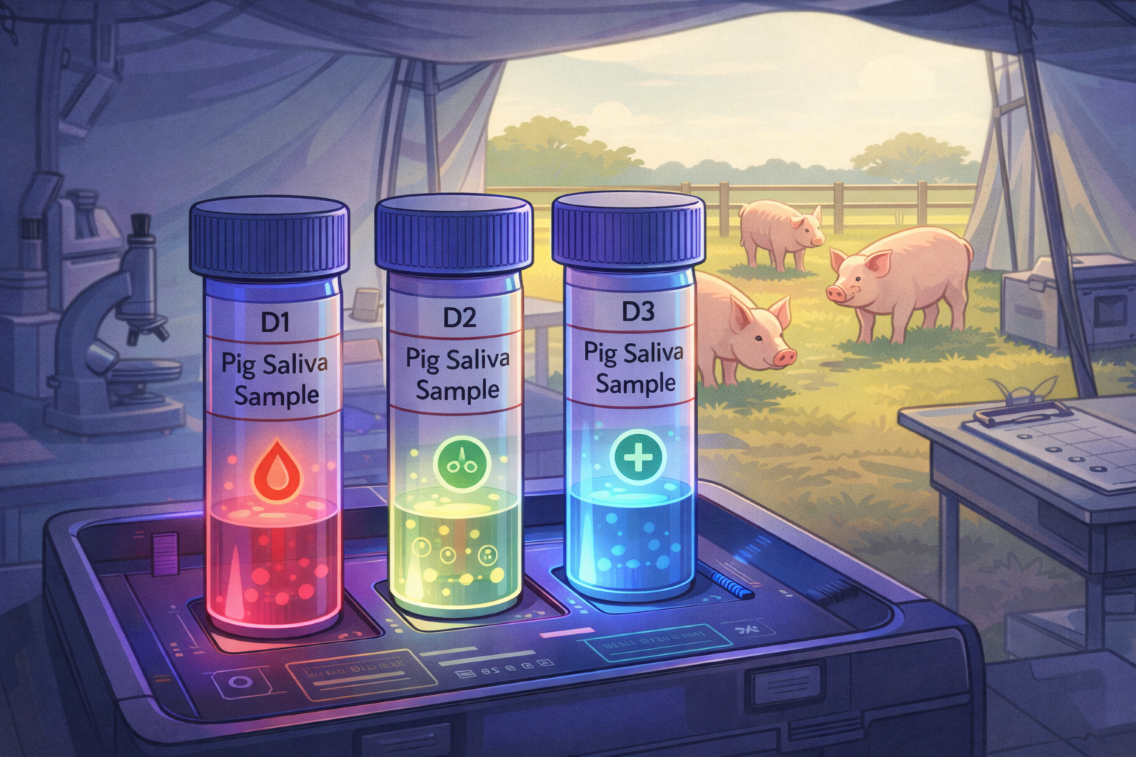
The biggest shift in swine biomarker work is practical: researchers want readouts that survive real-world variability. That’s pushing more studies toward non-invasive sampling (oral fluid/saliva), field-ready inflammation markers, and multi-marker panels.
Quick takeaways:
• Non-invasive matrices (oral fluid/saliva) are increasingly used for herd monitoring and biomarker research.1,2
• Acute-phase proteins and “field-tolerant” inflammation markers are common anchors for interpretation.2,3
• Matrix validation matters more than ever—saliva and serum are not interchangeable without checks.4
Reading map
- Trend 1 — Oral fluid & saliva as default matrices
- Trend 2 — Inflammation & acute-phase proteins as “field-ready” readouts
- Trend 3 — Infectious disease workflows (monitoring + immune response)
- Trend 4 — Welfare/stress physiology (non-invasive monitoring)
- Trend 5 — Emerging molecular readouts (next wave)
- What this means for ELISA kit selection
Trend 1 — Oral fluid & saliva as default matrices
Oral fluid collection is attractive because it’s non-invasive, scalable, and easier to standardize at pen level than repeated blood draws. Recent work links oral fluid biomarker measurements with herd indicators of health and performance, supporting its growing role in applied settings.1 A broader 2024 review summarizes how pig salivary analytes are being used for health monitoring and disease-related research.2
Why it’s happening
- Lower sampling stress and easier repeat sampling (especially for longitudinal designs).
- Population-level monitoring (one sample can represent a pen/herd context).
- More “real world”—oral fluid captures variability that serum-only sampling sometimes misses.
What teams measure in oral fluid/saliva
Trend 2 — Inflammation & acute-phase proteins as “field-ready” readouts
Cytokines remain important, but many swine teams pair them with acute-phase proteins (APPs) that better tolerate timing noise and field variability. ITIH4 (also known as Pig-MAP) is a classic example: it’s a positive APP in pigs with growing saliva/oral-fluid measurement interest.3,4
What this looks like in practice
- APP anchors: Pig-MAP/ITIH4, haptoglobin, SAA, CRP (depending on study design and availability).2,3
- “Explain the biology” add-ons: core cytokines (e.g., IL-6/TNF-α/IL-1β/IFN-γ) when kinetics matter.
- Why it helps: APPs can provide a stable “inflammation context” for interpreting more transient cytokines.
Trend 3 — Infectious disease workflows (monitoring + immune response)
Oral fluids are widely discussed for pathogen/antibody monitoring in swine systems, and the pig saliva analyte review highlights their use across multiple diseases, including PRRS surveillance contexts.2 On the biomarker side, studies of infectious conditions show coordinated changes in saliva analytes linked to inflammation, immune activation, and tissue damage markers.7,9
Trend 4 — Welfare/stress physiology (non-invasive monitoring)
Saliva is increasingly used to probe stress and welfare-relevant physiology because it can be collected repeatedly with minimal disruption. The 2024 review summarizes stress-linked analytes and practical considerations for salivary monitoring in pigs.2
Trend 5 — Emerging molecular readouts (next wave)
Beyond proteins and enzymes, porcine saliva is also being explored for molecular signals (e.g., salivary small RNAs) that could connect physiology with microbiome and environment. These approaches are still early-stage, but they’re expanding the “non-invasive biomarker” toolkit.10
What this means for ELISA kit selection
As teams diversify matrices, species + matrix validation becomes the primary selection criterion. A good example: a 2025 PLOS ONE study specifically evaluated commercial ELISA kits for measuring ITIH4 (Pig-MAP) in pig saliva, underscoring that saliva performance needs its own evidence.4
- Confirm matrix: serum vs plasma vs saliva/oral fluid vs lysate.
- Run a quick dilution series: check linearity before scaling up.
- Plan for field variability: hemolysis/lipemia/handling differences can dominate signal.
References
- Ornelas et al. “Associations between health, productive performance and oral fluid biomarker measurements in commercial pig farms.” BMC Veterinary Research (2024). Link
- “Advances in Research on Pig Salivary Analytes: A Window to Reveal Pig Health and Disease.” Animals (MDPI) (2024). Link
- “Pig-MAP, porcine acute phase proteins and standardisation…” Veterinary Research Communications (historical reference for Pig-MAP as APP). Link
- Ortín-Bustillo et al. “ITIH4 (Pig-MAP) in saliva of pigs: evaluation of two commercially available ELISA kits…” PLOS ONE (2025). Link
- Gutiérrez et al. “S100A12 protein as a porcine health status biomarker when quantified in saliva samples.” The Veterinary Journal (2024). Link
- Cerón et al. “Changes in salivary biomarkers of stress, inflammation, redox status… in pigs with Streptococcus suis infection.” BMC Veterinary Research (2023). Link
- “Gaining knowledge about biomarkers of the immune system… myeloperoxidase assay in porcine saliva.” Research in Veterinary Science (2023). Link
- “Changes in saliva and serum analytes in domestic pigs and wild boar…” (infection context; saliva biomarker shifts). Veterinary Research Communications / Springer (2025). Link
- “Exploring the potential of salivary small RNAs as non-invasive biomarkers…” Journal of Animal Science and Technology (2025). Link
Note: This article summarizes research trends for R&D use; it is not a clinical diagnostic guideline.