Loading ....
Newer / rising Porcine Biomarkers markers worth spotlighting
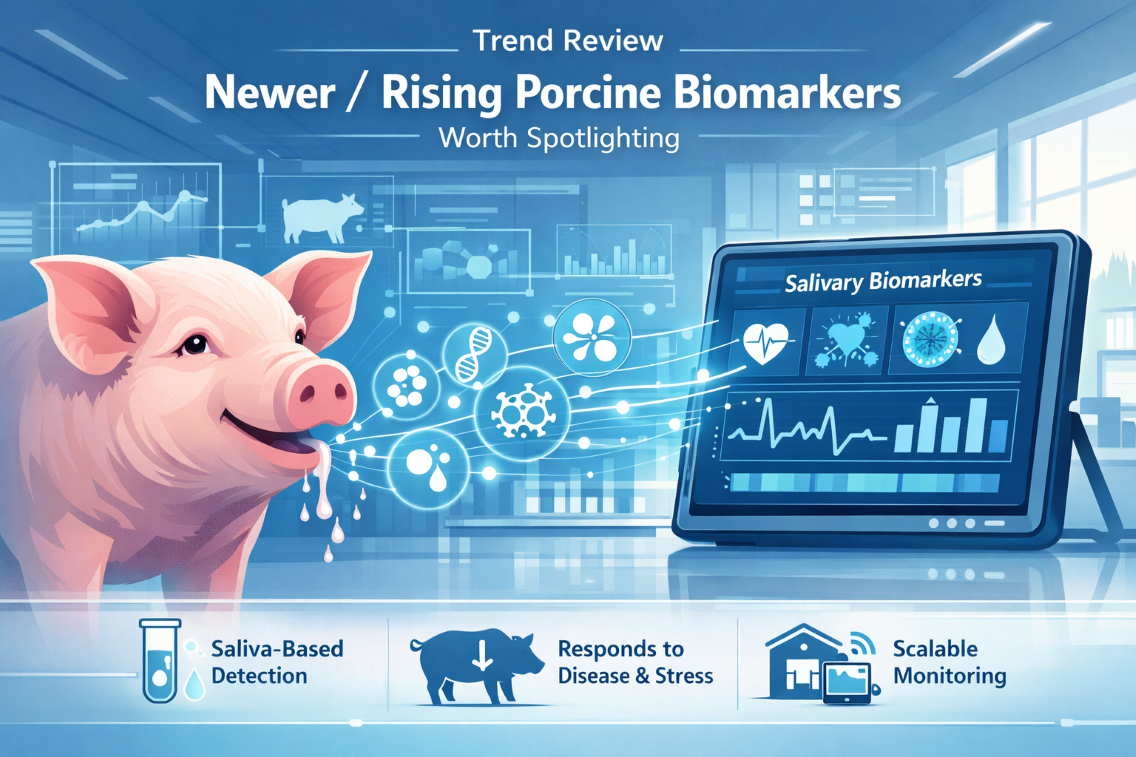
Newer / rising porcine biomarkers worth spotlighting
Beyond classic serum cytokines, a growing set of biomarkers is gaining attention because they can be measured in saliva/oral fluid, move robustly in real disease/stress contexts, and support scalable monitoring workflows.
At-a-glance: what’s “rising” and why
Pig-MAP / ITIH4
A positive acute-phase protein; increasingly measured beyond plasma into saliva contexts. 1,2
S100A12
Studied as a saliva “health status” biomarker with an immunoassay developed/validated for clinical porcine samples. 4
- Why it’s rising: measurable in saliva with robust differences between healthy vs diseased cohorts in published work. 4
- Where it helps: complements APPs; useful in inflammatory/respiratory disease contexts.
- Validation tip: standardize collection/processing; saliva is sensitive to handling effects.
Adenosine deaminase (ADA)
A marker of immune system activity; shows strong increases in saliva in infectious disease contexts in published studies. 5,6
- Why it’s rising: large fold-changes reported in saliva in infection-associated studies. 5
- Where it helps: “immune activation” signal that pairs well with APPs (Pig-MAP/ITIH4, Hp).
- Validation tip: confirm matrix and interference tolerance (lipemia/hemolysis variability).
Procalcitonin (PCT)
A sepsis-associated biomarker in humans; studied in pigs with assay development for saliva and evaluation in disease models. 7,5
- Why it’s rising: work shows feasibility of measuring PCT in pig saliva with validated assay approaches. 7
- Where it helps: supports systemic-inflammation/severity framing when paired with other markers.
- Validation tip: check LOD/LOQ and expected range—PCT can be low-abundance outside strong phenotypes.
Myeloperoxidase (MPO / Mpx)
Neutrophil-linked inflammation marker with assay development/validation in porcine saliva research. 8
- Why it’s rising: fits “inflammation + immune system” profiling in non-invasive sampling. 8
- Where it helps: adds mechanistic depth vs APP-only panels.
- Validation tip: keep collection consistent; saliva enzymes can be sensitive to processing.
How to validate “rising markers” quickly (before scaling your study)
- Matrix match: validate in your exact matrix (saliva/oral fluid vs serum/plasma). ITIH4/Pig-MAP saliva kit performance has been explicitly evaluated—use that as your standard for evidence expectations. 2
- Dilution linearity: run a broad dilution series to avoid hidden hook/high-background artifacts.
- Spike recovery: confirm that the matrix isn’t suppressing signal.
- Handling SOP: standardize collection device, centrifugation/clarification, freeze/thaw, and time-to-freezer.
References
- Pig-MAP as acute-phase protein context (historical): Veterinary Research Communications. Link
- Ortín-Bustillo et al. ITIH4 (Pig-MAP) in pig saliva: evaluation of commercial ELISA kits. PLOS ONE (2025). Link
- Piñeiro et al. Pig-MAP saliva quantitation immunoassay (time-resolved approach). Research in Veterinary Science (2024). Link
- Gutiérrez et al. S100A12 as porcine saliva health-status biomarker; immunoassay development/validation. The Veterinary Journal (2024). Link
- Cerón et al. Salivary biomarkers of stress/inflammation/redox/muscle damage in pigs with S. suis infection (incl. ADA/PCT/LDH signals). BMC Veterinary Research (2023). Link
- MDPI (IJMS) proteomics/validation context including ADA performance in meningitis. International Journal of Molecular Sciences (2022). Link
- “Measurement of procalcitonin in saliva of pigs: a pilot study.” BMC Veterinary Research (2022). Link
- Myeloperoxidase (Mpx) assay development/validation and factors influencing Mpx/S100A12/ITIH4 in porcine saliva. Research in Veterinary Science (2023). Link
- Infection-context saliva and serum analyte shifts (incl. haptoglobin/S100 proteins/ADA/LDH). Springer (2025). Link
Note: This article summarizes research findings for R&D planning; it is not a clinical diagnostic guideline.