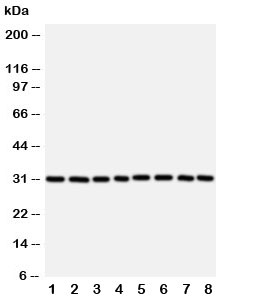
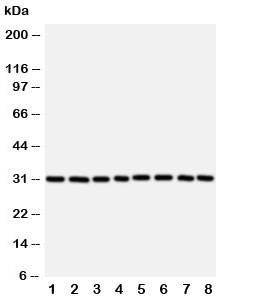
The voltage-dependent anion channel of the outer mitochondrial membrane is a small, abundant outer membrane pore-forming protein found in the outer membranes of all eukaryotic mitochondria. The protein is though to form the major pathway for movement of adenine nucleotides through the outer membrane and to be the mitochondrial binding site for hexokinase and glycerol kinase. At low transmembrane voltage, VDAC1 is open for anions such as phosphate, chloride, and adenine nucleotides. At higher transmembrane voltage, VDAC1 functions as a selective channel for cations and uncharged molecules. These features make it likely the protein plays a role in mitochondrial energy metabolism. Huizing et al. studied by Northern and Western blot analyses the human tissue distribution of mitochondrial transmembrane metabolite carriers. VDAC1 mRNA has a ubiquitous distribution, with most pronounced expression in heart, liver, and skeletal muscle, whereas the VDAC2 isoform appears to be expressed only in the heart.
Formulation
0.5mg/ml if reconstituted with 0.2ml sterile DI water
Host
Rabbit
Immunogen Region
An amino acid sequence from the middle region of human Voltage-dependent anion channel 1 (RVTQSNFAVGYKTDEF) was used as the immunogen for this VDAC1 antibody (100% homologous in human, mouse and rat).
Isotype
IgG
Predicted Reactivity
Human, Mouse, Rat
Reactivity
Mouse, Rat, Human
Recombinant
No
Antigen
VDAC1
Uniprot
P21796
Format
Antigen affinity purified
Purification
Antigen affinity
Storage
After reconstitution, the VDAC1 antibody can be stored for up to one month at 4°C. For long-term, aliquot and store at -20°C. Avoid repeated freezing and thawing.
Applications
IHC-P, IHC-F, WB, ICC
Dilution
Western blot: 0.5-1ug/ml,Immunohistochemistry (FFPE): 0.5-1ug/ml,Immunohistochemistry (Frozen): 0.5-1ug/ml,Immunocytochemistry: 0.5-1ug/ml
 Loading ....