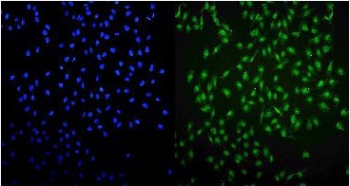
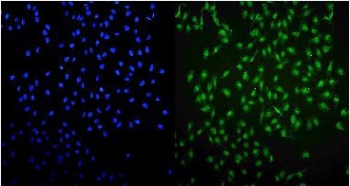
Ubiquitin-like, containing PHD and RING finger domains, 1 is a protein which in humans is encoded by the UHRF1 gene. This gene encodes a member of a subfamily of RING-finger type E3 ubiquitin ligases. The protein binds to specific DNA sequences, and recruits a histone deacetylase to regulate gene expression. Its expression peaks at late G1 phase and continues during G2 and M phases of the cell cycle. It plays a major role in the G1/S transition by regulating topoisomerase IIalpha and retinoblastoma gene expression, and functions in the p53-dependent DNA damage checkpoint. It is regarded as a hub protein for the integration of epigenetic information. This gene is up-regulated in various cancers, and it is therefore considered to be a therapeutic target. Multiple transcript variants encoding different isoforms have been found for this gene. A related pseudogene exists on chromosome 12.
Formulation
0.5mg/ml if reconstituted with 0.2ml sterile DI water
Host
Rabbit
Immunogen Region
Amino acids HTVDSLSRLTKVEELRRKIQELFHVEPGLQRLFYRGKQ of human UHRF1 were used as the immunogen for the UHRF1 antibody.
Isotype
IgG
Predicted Reactivity
Human
Reactivity
Human
Recombinant
No
Subcellular Location
Nuclear
Antigen
UHRF1
Uniprot
Q96T88
Format
Antigen affinity purified
Purification
Antigen affinity
Storage
After reconstitution, the UHRF1 antibody can be stored for up to one month at 4°C. For long-term, aliquot and store at -20°C. Avoid repeated freezing and thawing.
Applications
IF, FACS, IHC-P, WB
Dilution
Western blot: 0.1-0.5ug/ml,Immunohistochemistry (FFPE): 0.5-1ug/ml,Flow cytometry: 1-3ug/million cells,Immunofluorescence (FFPE): 2-4ug/ml
 Loading ....