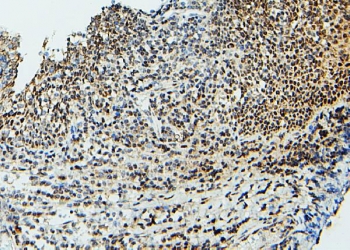
SUMO-conjugating enzyme UBC9 (UBE2I), also called UBC9, is a protein that in humans is encoded by the UBE2I gene. This gene encodes a member of the E2 ubiquitin-conjugating enzyme family. It is mapped to 16p13.3. UBC9 could fully complement the mutant phenotype of a yeast ubc9 mutant strain. This gene may play a similar role via interaction with WT1, which is able to impose a block to cell cycle progression in eukaryotic cells. What's more, it could support the growth of yeast ubc9 temperature-sensitive mutants at nonpermissive temperatures, indicating that the gene is a functional homolog of yeast ubc9. UBC9 is specifically associated with FHIT, such as FHIT may be involved in cell cycle control through its interaction with UBC9.
Formulation
0.5mg/ml if reconstituted with 0.2ml sterile DI water
Host
Rabbit
Immunogen Region
A human recombinant protein (amino acids K65-K146 ) was used as the immunogen for the UBC9 antibody.
Isotype
IgG
Predicted Reactivity
Human, Mouse, Rat
Reactivity
Mouse, Rat, Human
Recombinant
No
Subcellular Location
Nuclear
Antigen
UBC9
Uniprot
P63279
Buffer
Lyophilized from 1X PBS with 2% Trehalose and 0.025% sodium azide
Format
Antigen affinity purified
Purification
Affinity purified
Storage
After reconstitution, the UBC9 antibody can be stored for up to one month at 4°C. For long-term, aliquot and store at -20°C. Avoid repeated freezing and thawing.
Applications
IHC-P, FACS, WB, Direct ELISA
Dilution
Western blot: 0.25-0.5ug/ml,Immunohistochemistry (FFPE): 1-2ug/ml,Flow cytometry: 1-3ug/million cells,Direct ELISA: 0.1-0.5ug/ml
 Loading ....