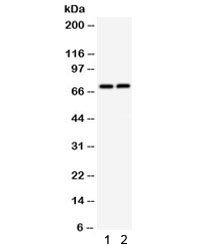
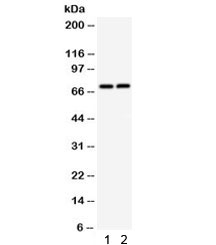
Tumor necrosis factor receptor 2 (TNFR2) is one of receptors of TNF. TNF has proinflammatory and immunosuppressive properties that may segregate at the level of the 2 TNF receptors (TNFRs), TNFR1 and TNFR2. The genes for TNFR1, a 55-kDa protein, and TNFR2, a 70-kDa protein, have been mapped to human chromosomes 12 (12pter-cen) and 1 (1pter-p32), respectively. TNFR2 was induced on glomerular endothelial cells of nephritic kidneys, and TNFR2 expression on intrinsic cells, but not leukocytes, was essential for glomerulonephritis and glomerular complement deposition. TNFR1 promotes systemic immune responses and renal T cell death, while intrinsic cell TNFR2 plays a critical role in complement-dependent tissue injury. Therefore, therapeutic blockade specifically of TNFR2 may be a promising strategy in the treatment of immune-mediated glomerulonephritis.
Formulation
0.5mg/ml if reconstituted with 0.2ml sterile DI water
Host
Rabbit
Immunogen Region
Amino acids QRDAKVPHVPDEKSQDAVGLEQQHLLTTA of mouse TNF Receptor II were used as the immunogen for the TNFRSF1B antibody.
Isotype
IgG
Predicted Reactivity
Mouse, Rat
Reactivity
Mouse, Rat
Recombinant
No
Subcellular Location
Cytoplasmic, membrane
Antigen
TNF Receptor II
Uniprot
P25119
Format
Antigen affinity purified
Purification
Antigen affinity
Storage
After reconstitution, the TNFRSF1B antibody can be stored for up to one month at 4°C. For long-term, aliquot and store at -20°C. Avoid repeated freezing and thawing.
Applications
IHC-P, WB
Dilution
Western blot: 0.1-0.5ug/ml,Immunohistochemistry (FFPE): 0.5-1ug/ml
 Loading ....