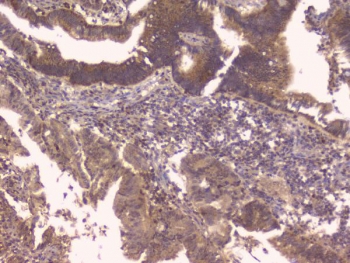
Tumor necrosis factor receptor superfamily member 11B (TNFRSF11B), also known as OPG, is a protein that in humans is encoded by the TNFRSF11B gene. OPG is a cytokine receptor, and a member of the tumor necrosis factor (TNF) receptor superfamily. By analysis of radiation hybrids, TNFRSF11B gene was mapped to chromosome 8q24. OPG is a decoy receptor for the receptor activator of nuclear factor kappa B ligand (RANKL). By binding RANKL, OPG inhibits nuclear kappa B (NF-?B) which is a central and rapid acting transcription factor for immune-related genes, and a key regulator of inflammation, innate immunity, and cell survival and differentiation. OPG binding to RANKL on osteoblast/stromal cells, blocks the RANKL-RANK ligand interaction between osteoblast/stromal cells and ostepclast precursors.
Formulation
0.5mg/ml if reconstituted with 0.2ml sterile DI water
Host
Rabbit
Immunogen Region
A human recombinant protein (amino acids Q247-R296) was used as the immunogen for the TNFRSF11B antibody.
Isotype
IgG
Predicted Reactivity
Human, Mouse, Rat
Reactivity
Mouse, Rat, Human
Recombinant
No
Antigen
Osteoprotegerin
Uniprot
O00300
Buffer
Lyophilized from 1X PBS with 2% Trehalose and 0.025% sodium azide
Format
Antigen affinity purified
Purification
Affinity purified
Storage
After reconstitution, the TNFRSF11B antibody can be stored for up to one month at 4°C. For long-term, aliquot and store at -20°C. Avoid repeated freezing and thawing.
Applications
IHC-P, FACS, WB, Direct ELISA
Dilution
Western blot: 0.25-0.5ug/ml,Immunohistochemistry (FFPE): 1-2ug/ml,Flow cytometry: 1-3ug/million cells,Direct ELISA: 0.1-0.5ug/ml
 Loading ....