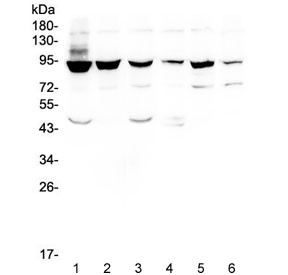
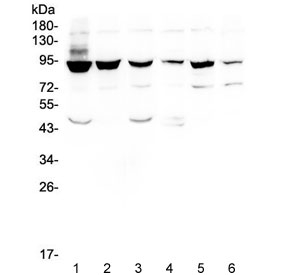
Signal transducer and activator of transcription 1 is a transcription factor which in humans is encoded by the STAT1 gene. The protein encoded by this gene is a member of the STAT protein family. In response to cytokines and growth factors, STAT family members are phosphorylated by the receptor associated kinases, and then form homo- or heterodimers that translocate to the cell nucleus where they act as transcription activators. This protein can be activated by various ligands including interferon-alpha, interferon-gamma, EGF, PDGF and IL6. This protein mediates the expression of a variety of genes, which is thought to be important for cell viability in response to different cell stimuli and pathogens. Two alternatively spliced transcript variants encoding distinct isoforms have been described.
Formulation
0.5mg/ml if reconstituted with 0.2ml sterile DI water
Host
Rabbit
Immunogen Region
Amino acids S2-A230 from the human protein were used as the immunogen for the STAT1 antibody.
Isotype
IgG
Predicted Reactivity
Human, Mouse, Rat, Monkey
Reactivity
Rat, Monkey, Mouse, Human
Recombinant
No
Subcellular Location
Cytoplasmic, nuclear
Antigen
STAT1
Uniprot
P42224
Buffer
Lyophilized from 1X PBS with 2.5% BSA, 0.025% sodium azide
Format
Antigen affinity purified
Purification
Antigen affinity
Storage
After reconstitution, the STAT1 antibody can be stored for up to one month at 4°C. For long-term, aliquot and store at -20°C. Avoid repeated freezing and thawing.
Applications
FACS, ICC, IF, IHC-P, WB
Dilution
Western blot: 0.5-1ug/ml,Immunohistochemistry (FFPE): 1-2ug/ml,Immunofluorescence/Immunocytochemistry (FFPE): 2-4ug/ml,Flow cytometry: 1-3ug/million cells
 Loading ....