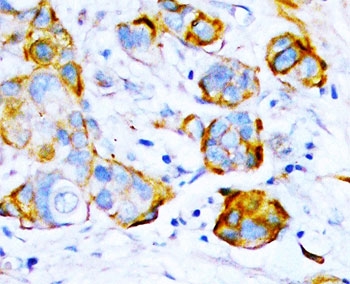
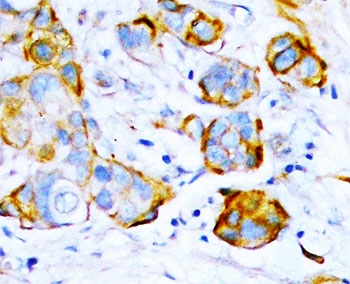
The tyrosine phosphatase SHP2 is recruited into tyrosine-kinase signalling pathways through binding of its two amino-terminal SH2 domains to specific phosphotyrosine motifs, concurrent with its re-localization and stimulation of phosphatase activity. It can potentiate signalling through the MAP-kinase pathway and is required during early mouse development for gastrulation. SHP2 is specifically required in mesenchyme cells of the progress zone(PZ), directly beneath the distal ectoderm of the limb bud. Rather than integrating proliferative signals, it probably exerts its effects on limb development by influencing cell shape, movement or adhesion. Furthermore, the branchial arches, which also use Fgfs during bud outgrowth, similarly require Shp2. Thus, it regulates phosphotyrosine-signalling events during the complex ectodermal-mesenchymal interactions that regulate mammalian budding morphogenesis.
Formulation
0.5mg/ml if reconstituted with 0.2ml sterile DI water
Host
Rabbit
Immunogen Region
An amino acid sequence from the C-terminus of human SHP2 (EDSARVYENVGLMQQ) was used as the immunogen for this SHP2 antibody (100% homologous in human, mouse and rat).
Isotype
IgG
Predicted Reactivity
Human
Reactivity
Human
Recombinant
No
Antigen
SHP2
Uniprot
Q06124
Buffer
Lyophilized from 1X PBS with 2% Trehalose
Format
Antigen affinity purified
Purification
Antigen affinity
Storage
After reconstitution, the SHP2 antibody can be stored for up to one month at 4°C. For long-term, aliquot and store at -20°C. Avoid repeated freezing and thawing.
Applications
WB, IHC-P
Dilution
Western blot: 0.5-1ug/ml,Immunohistochemistry (FFPE): 0.5-1ug/ml
 Loading ....