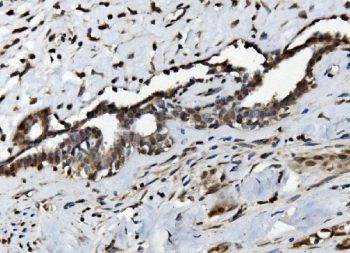
Serum response factor, also known as SRF, is a transcription factor protein. This gene encodes a ubiquitous nuclear protein that stimulates both cell proliferation and differentiation. It is a member of the MADS (MCM1, Agamous, Deficiens, and SRF) box superfamily of transcription factors. This protein binds to the serum response element (SRE) in the promoter region of target genes. This protein regulates the activity of many immediate-early genes, for example c-fos, and thereby participates in cell cycle regulation, apoptosis, cell growth, and cell differentiation. This gene is the downstream target of many pathways; for example, the mitogen-activated protein kinase pathway (MAPK) that acts through the ternary complex factors (TCFs). Two transcript variants encoding different isoforms have been found for this gene.
Formulation
0.5mg/ml if reconstituted with 0.2ml sterile DI water
Host
Rabbit
Immunogen Region
Recombinant human protein (amino acids K154-E508) was used as the immunogen for the Serum Response Factor antibody.
Isotype
IgG
Predicted Reactivity
Human
Reactivity
Human
Recombinant
No
Subcellular Location
Nuclear
Antigen
Serum Response Factor
Uniprot
P11831
Buffer
Lyophilized from 1X PBS with 2% Trehalose
Format
Purified
Purification
Antigen affinity purified
Storage
After reconstitution, the Serum Response Factor antibody can be stored for up to one month at 4°C. For long-term, aliquot and store at -20°C. Avoid repeated freezing and thawing.
 Loading ....