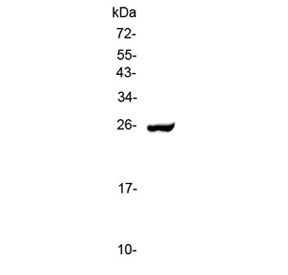
Amyloid P component, serum (SAP), also known as PTX2 or APCS, is the identical serum form of amyloid P component (AP), a 25kDa pentameric protein first identified as the pentagonal constituent of in vivo pathological deposits called amyloid. It belongs to the pentraxins family, characterised by calcium dependent ligand binding and distinctive flattened β-jellyroll structure similar to that of the legume lectins. This gene is mapped to 1q23.2. The binding of the encoded protein to proteins in the pathological amyloid cross-beta fold suggests its possible role as a chaperone. This protein is also thought to control the degradation of chromatin. It has been demonstrated that this protein binds to apoptotic cells at an early stage, which raises the possibility that it is involved in dealing with apoptotic cells in vivo.
Formulation
0.5mg/ml if reconstituted with 0.2ml sterile DI water
Host
Rabbit
Immunogen Region
A recombinant human protein corresponding to amino acids H20-L220 was used as the immunogen for the Serum Amyloid P antibody.
Isotype
IgG
Predicted Reactivity
Human
Reactivity
Human
Recombinant
No
Subcellular Location
Secreted
Antigen
Serum Amyloid P
Uniprot
P02743
Buffer
Lyophilized from 1X PBS with 2% Trehalose and 0.025% sodium azide
Format
Antigen affinity purified
Purification
Antigen affinity
Storage
The lyophilized Serum Amyloid P antibody can be stored at 4°C to -20°C. After reconstitution, aliquot and store at -20°C. Avoid repeated freeze/thaws.
Applications
ELISA, IHC-P, WB
Dilution
Western blot: 0.5-1ug/ml,Immunohistochemistry (FFPE): 1-2ug/ml,Direct ELISA: 0.1-0.5ug/ml
 Loading ....