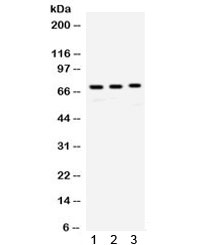
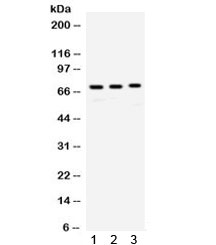
Replication protein A 70 kDa DNA-binding subunit is a protein that in humans is encoded by the RPA1 gene. This gene is mapped to chromosome 17p13.3. Replication protein A (RPA) is a heterotrimeric single-strand DNA (ssDNA)-binding protein essential for DNA replication, repair, and recombination. It is composed of 70-kD (RPA1), 32-kD (RPA2), and 14-kD (RPA3) subunits. The RPA1 subunit is responsible for high-affinity ssDNA binding. The RPA complex was originally isolated as a factor essential for in vitro replication of the papovavirus SV40. It had been found that recombinant human RPA1, purified from bacteria, exhibited ssDNA-binding activity comparable to that of the complete RPA complex. RPA1 could substitute for the complete complex in stimulating the activity of DNA polymerase alpha-primase, but it could not substitute for the complete complex in SV40 DNA replication in vitro, suggesting an important functional role for the other subunits.
Formulation
0.5mg/ml if reconstituted with 0.2ml sterile DI water
Host
Rabbit
Immunogen Region
Amino acids QESAEAILGQNAAYLGELKDKNEQAFEEVFQNANFR of human RPA1 were used as the immunogen for the RPA1 antibody.
Isotype
IgG
Predicted Reactivity
Human
Reactivity
Human
Recombinant
No
Antigen
RPA70
Uniprot
P27694
Format
Antigen affinity purified
Purification
Antigen affinity
Storage
After reconstitution, the RPA1 antibody can be stored for up to one month at 4°C. For long-term, aliquot and store at -20°C. Avoid repeated freezing and thawing.
 Loading ....