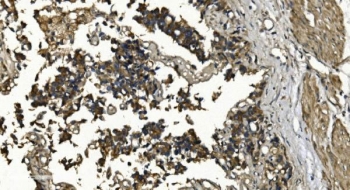
Regulator of G-protein signaling 6 is a protein that in humans is encoded by the RGS6 gene. This gene encodes a member of the RGS (regulator of G protein signaling) family of proteins, which are defined by the presence of a RGS domain that confers the GTPase-activating activity of these proteins toward certain G alpha subunits. This protein also belongs to a subfamily of RGS proteins characterized by the presence of DEP and GGL domains, the latter a G beta 5-interacting domain. The RGS proteins negatively regulate G protein signaling, and may modulate neuronal, cardiovascular, lymphocytic activities, and cancer risk. Many alternatively spliced transcript variants encoding different isoforms with long or short N-terminal domains, complete or incomplete GGL domains, and distinct C-terminal domains, have been described for this gene, however, the full-length nature of some of these variants is not known.
Formulation
0.5mg/ml if reconstituted with 0.2ml sterile DI water
Host
Rabbit
Immunogen Region
A human recombinant partial protein (amino acids D7-E357) was used as the immunogen for the RGS6 antibody.
Isotype
IgG
Predicted Reactivity
Human, Mouse, Rat
Reactivity
Mouse, Rat, Human
Recombinant
No
Subcellular Location
Nuclear, cytoplasmic
Antigen
RGS6
Uniprot
P49758
Format
Antigen affinity purified
Purification
Affinity purified
Storage
After reconstitution, the RGS6 antibody can be stored for up to one month at 4°C. For long-term, aliquot and store at -20°C. Avoid repeated freezing and thawing.
Applications
IHC-P, FACS, WB, Direct ELISA
Dilution
Western blot: 1-2ug/ml,Immunohistochemistry (FFPE): 2-5ug/ml,Flow cytometry: 1-3ug/million cells,Direct ELISA: 0.1-0.5ug/ml
 Loading ....