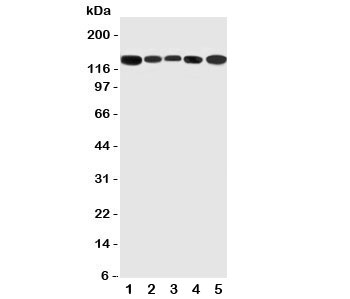
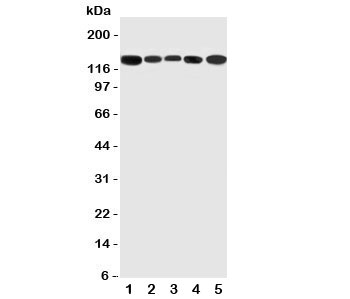
Regulator of G Protein Signaling 3 is a protein that in humans is encoded by the RGS3 gene. Chatterjee et al.(1997) studied RGS3, the largest member of the RGS family then identified. Mouse Pdz-Rgs3 can mediate signaling from the ephrin-B cytoplasmic tail. By radiation hybrid mapping, Chatterjee et al.(1997) assigned the gene to chromosome 9q31-q33. Lu et al.(2001) showed that Sdf1, a chemokine with a G protein-coupled receptor, and Bdnf are chemoattractants for cerebellar granule cells, and that Sdf1 chemoattraction is selectively inhibited by soluble ephrin-B receptor. This inhibition could be blocked by a truncated Pdz-Rgs3 protein lacking the RGS domain.
Formulation
0.5mg/ml if reconstituted with 0.2ml sterile DI water
Host
Rabbit
Immunogen Region
An amino acid sequence from the C-terminus of mouse Regulator of G Protein Signaling 3 (DSYTREHTKENLQSITR) was used as the immunogen for this RGS3 antibody (100% rat homology).
Isotype
IgG
Predicted Reactivity
Human, Mouse, Rat
Reactivity
Human, Mouse, Rat
Recombinant
No
Antigen
RGS3
Uniprot
Q9DC04
Format
Antigen affinity purified
Purification
Antigen affinity
Storage
After reconstitution, the RGS3 antibody can be stored for up to one month at 4°C. For long-term, aliquot and store at -20°C. Avoid repeated freezing and thawing.
Applications
IHC-P, WB
Dilution
Western blot: 0.5-1ug/ml,Immunohistochemistry (FFPE): 0.5-1ug/ml
 Loading ....