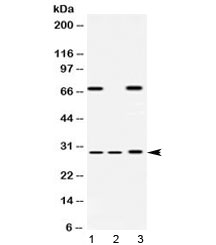
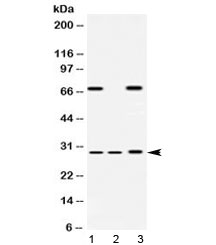
Proteasome subunit alpha type-4, also known as macropain subunit C9, proteasome component C9, and 20S proteasome subunit alpha-3, is a protein that in humans is encoded by the PSMA4 gene. The proteasome is a multicatalytic proteinase complex with a highly ordered ring-shaped 20S core structure. The core structure is composed of 4 rings of 28 non-identical subunits; 2 rings are composed of 7 alpha subunits and 2 rings are composed of 7 beta subunits. Proteasomes are distributed throughout eukaryotic cells at a high concentration and cleave peptides in an ATP/ubiquitin-dependent process in a non-lysosomal pathway. An essential function of a modified proteasome, the immunoproteasome, is the processing of class I MHC peptides. This gene encodes a member of the peptidase T1A family, that is a 20S core alpha subunit. Three alternatively spliced transcript variants encoding different isoforms have been found for this gene.
Formulation
0.5mg/ml if reconstituted with 0.2ml sterile DI water
Host
Rabbit
Immunogen Region
Amino acids 84-123 (NVLTNELRLIAQRYLLQYQEPIPCEQLVTALCDIKQAYTQ) from the human protein were used as the immunogen for the PSMA4 antibody.
Isotype
IgG
Predicted Reactivity
Human, Mouse, Rat
Reactivity
Human, Mouse, Rat
Recombinant
No
Subcellular Location
Cytoplasmic, nuclear
Antigen
PSMA4
Uniprot
P25789
Buffer
Lyophilized from 1X PBS with 2.5% BSA and 0.025% sodium azide
Format
Antigen affinity purified
Purification
Antigen affinity
Storage
After reconstitution, the PSMA4 antibody can be stored for up to one month at 4°C. For long-term, aliquot and store at -20°C. Avoid repeated freezing and thawing.
 Loading ....