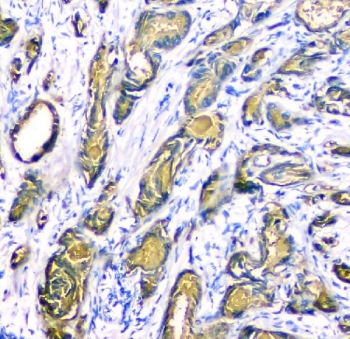
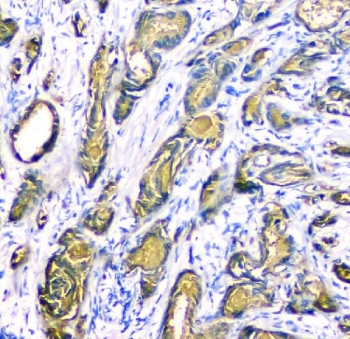
Prostate-specific antigen (PSA), also known as gamma-seminoprotein or kallikrein-3 (KLK3), is a glycoprotein enzyme encoded in humans by the KLK3 gene. It is a member of the kallikrein-related peptidase family and is secreted by the epithelial cells of the prostate gland. This gene is mapped to 19q13.33. PSA is present in small quantities in the serum of men with healthy prostates, but is often elevated in the presence of prostate cancer or other prostate disorders. It is produced for the ejaculate where it liquifies the semen in the seminal coagulum and allows sperm to swim freely. It is also believed to be instrumental in dissolving the cervical mucous cap, allowing the entry of sperm. PSA level is not a unique indicator of prostate cancer, but may also detect prostatitis or benign prostatic hyperplasia.
Formulation
0.5mg/ml if reconstituted with 0.2ml sterile DI water
Host
Rabbit
Immunogen Region
Human partial recombinant protein (AA 25-261) was used as the immunogen for this PSA antibody.
Isotype
IgG
Predicted Reactivity
Human
Reactivity
Human
Recombinant
No
Antigen
PSA
Uniprot
P07288
Gene Id
354
Format
Antigen affinity purified
Purification
Antigen affinity
Storage
After reconstitution, the PSA antibody can be stored for up to one month at 4°C. For long-term, aliquot and store at -20°C. Avoid repeated freezing and thawing.
Applications
WB, IHC-P
Dilution
Western blot: 0.5-1ug/ml,Immunohistochemistry (FFPE): 1-2ug/ml
 Loading ....