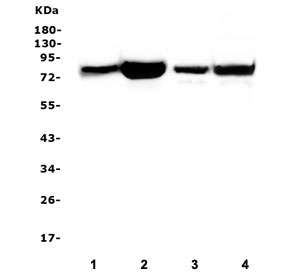
Protein kinase C delta type, also called PKCD, is an enzyme that in humans is encoded by the PRKCD gene. The PRKCD gene encodes a member of the protein kinase C family, members of which are critical for regulation of cell survival, proliferation, and apoptosis. This gene is mapped to 3p21.1. Studies both in human and mice demonstrate that this kinase is involved in B cell signaling and in the regulation of growth, apoptosis, and differentiation of a variety of cell types. PRKCD is also regulated by phosphorylation on various tyrosine residues including Y311 (by SRC). It has been showed that PRKCD phosphorylates NLRC4 and that this phosphorylation is critical for inflammasome assembly. It is also a part of a noncanonical WNT signaling cascade.
Formulation
0.5mg/ml if reconstituted with 0.2ml sterile DI water
Host
Rabbit
Immunogen Region
A human recombinant protein (amino acids F4-D676) was used as the immunogen for the PRKCD antibody.
Isotype
IgG
Predicted Reactivity
Human, Mouse, Rat
Reactivity
Mouse, Rat, Human
Recombinant
No
Subcellular Location
Cytoplasmic, nuclear, plasma membrane
Antigen
PKC delta
Uniprot
Q05655
Buffer
Lyophilized from 1X PBS with 2% Trehalose and 0.025% sodium azide
Format
Antigen affinity purified
Purification
Affinity purified
Storage
After reconstitution, the PRKCD antibody can be stored for up to one month at 4°C. For long-term, aliquot and store at -20°C. Avoid repeated freezing and thawing.
 Loading ....