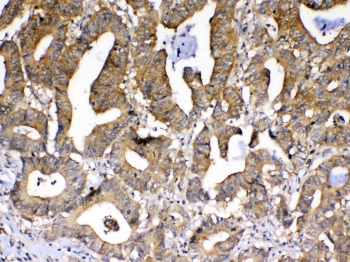
Peptidyl-prolyl cis-trans isomerase D, also known as PPID and Cyclophilin 40, is an enzyme which in humans is encoded by the PPID gene. The protein encoded by this gene is a member of the peptidyl-prolyl cis-trans isomerase (PPIase) family. The gene contains 10 exons and spans 14.2 kb of genomic DNA. By fluorescence in situ hybridization, the PPID gene is mapped to chromosome 4q31.3. PPIases catalyze the cis-trans isomerization of proline imidic peptide bonds in oligopeptides and accelerate the folding of proteins. This protein has been shown to possess PPIase activity and, similar to other family members, can bind to the immunosuppressant ciclosporin.
Formulation
0.5mg/ml if reconstituted with 0.2ml sterile DI water
Host
Rabbit
Immunogen Region
A recombinant human partial protein corresponding to amino acids N306-A370 was used as the immunogen for the PPID antibody.
Isotype
IgG
Predicted Reactivity
Human, Mouse, Rat
Reactivity
Mouse, Rat, Human
Recombinant
No
Subcellular Location
Cytoplasmic, nuclear
Antigen
PPID
Uniprot
Q08752
Buffer
Lyophilized from 1X PBS with 2% Trehalose and 0.025% sodium azide
Format
Antigen affinity purified
Purification
Antigen affinity purified
Storage
After reconstitution, the PPID antibody can be stored for up to one month at 4°C. For long-term, aliquot and store at -20°C. Avoid repeated freezing and thawing.
Applications
IHC-P, FACS, WB, ELISA
Dilution
Western Blot: 0.5-1ug/ml,Immunohistochemistry (FFPE): 1-2ug/ml,Flow cytometry: 1-3ug/million cells,Direct ELISA: 0.1-0.5ug/ml
 Loading ....