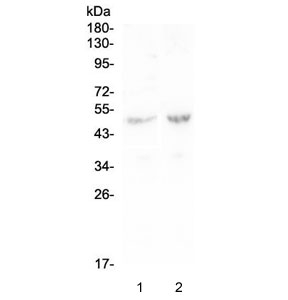
Lipoprotein-associated phospholipase A2 (Lp-PLA2), also known as platelet-activating factor acetylhydrolase (PAF-AH), is a phospholipase A2 enzyme that in humans is encoded by the PLA2G7 gene. Lp-PLA2 is a 45-50 kDa protein of 441 amino acids. It is one of several PAF acetylhydrolases. In the blood it travels mainly with low-density lipoprotein (LDL). Less than 20% is associated with high-density lipoprotein HDL. It is an enzyme produced by inflammatory cells and hydrolyzes oxidized phospholipids in LDL. Lp-PLA2 is platelet-activating factor (PAF) acetylhydrolase, a secreted enzyme that catalyzes the degradation of PAF to inactive products by hydrolysis of the acetyl group at the sn-2 position, producing the biologically inactive products LYSO-PAF and acetate.
Formulation
0.5mg/ml if reconstituted with 0.2ml sterile DI water
Host
Rabbit
Immunogen Region
Amino acids A176-N415 from the human protein were used as the immunogen for the PLA2G7 antibody.
Isotype
IgG
Predicted Reactivity
Human
Reactivity
Human
Recombinant
No
Antigen
PLA2G7
Uniprot
Q13093
Format
Purified
Purification
Antigen affinity purified
Storage
After reconstitution, the PLA2G7 antibody can be stored for up to one month at 4°C. For long-term, aliquot and store at -20°C. Avoid repeated freezing and thawing.
Applications
WB, ELISA
Dilution
Western blot: 0.5-1ug/ml,ELISA (Capture): 1-5ug/ml (human recombinant protein)
 Loading ....