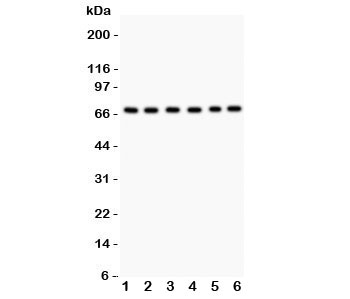
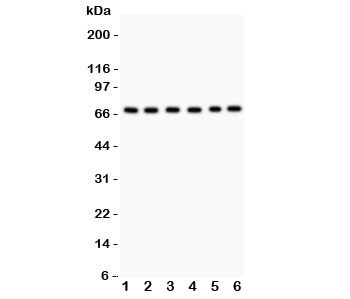
Protein kinase C iota, also called PKCI, is an enzyme that in humans is encoded by the PRKCI gene. This gene encodes a member of the protein kinase C (PKC) family of serine/threonine protein kinases. This protein kinase is calcium-independent and phospholipid-dependent. It is not activated by phorbolesters or diacylglycerol. This kinase can be recruited to vesicle tubular clusters (VTCs) by direct interaction with the small GTPase RAB2, where it phosphorylates glyceraldehyde-3-phosphate dehydrogenase (GAPD/GAPDH) and plays a role in microtubule dynamics in the early secretory pathway. PRKCI is found to be necessary for BCL-ABL-mediated resistance to drug-induced apoptosis and therefore protects leukemia cells against drug-induced apoptosis. It is also a hedgehog target gene that forms a positive feedback loop with GLI and exists at increased levels in basal cell carcinomas.
Formulation
0.5mg/ml if reconstituted with 0.2ml sterile DI water
Host
Rabbit
Immunogen Region
Human partial recombinant protein (AA 21-214) was used as the immunogen for this PKC iota antibody.
Isotype
IgG
Predicted Reactivity
Human, Mouse, Rat
Reactivity
Human, Mouse, Rat
Recombinant
No
Antigen
PKC iota
Gene Id
5584
Format
Antigen affinity purified
Purification
Antigen affinity
Storage
After reconstitution, the PKC iota antibody can be stored for up to one month at 4°C. For long-term, aliquot and store at -20°C. Avoid repeated freezing and thawing.
Applications
IHC-P, WB
Dilution
Western blot: 0.5-1ug/ml,Immunohistochemistry (FFPE): 0.5-1ug/ml
 Loading ....