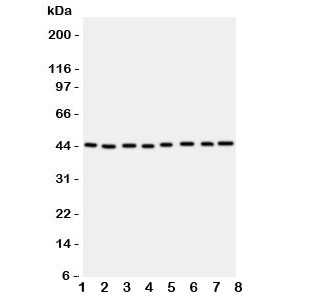
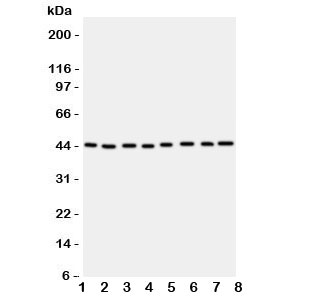
Phosphoglycerate Kinase 1, also known as PGKA, is an enzyme that in humans is encoded by the PGK1 gene. Willard et al.(1985) used a cDNA for human PGK to map the functional PGK1 gene to Xq13. Disulfide bonds in secreted proteins are considered to be inert because of the oxidizing nature of the extracellular milieu. An exception to this rule is a reductase secreted by tumor cells that reduces disulfide bonds in the serine proteinase plasmin. Lay et al.(2000) showed that the plasmin reductase isolated from conditioned medium of fibrosarcoma cells is the glycolytic enzyme phosphoglycerate kinase. Recombinant phosphoglycerate kinase had the same specific activity as the fibrosarcoma-derived protein. Plasma of mice bearing fibrosarcoma tumors contained several-fold more phosphoglycerate kinase, as compared with mice without tumors.
Formulation
0.5mg/ml if reconstituted with 0.2ml sterile DI water
Host
Rabbit
Immunogen Region
An amino acid sequence from the middle region of human Phosphoglycerate Kinase 1 (FGTAHRAHSSMVGVN) was used as the immunogen for this PGK1 antibody (100% homologous in human, mouse and rat).
Isotype
IgG
Predicted Reactivity
Human, Mouse, Rat
Reactivity
Human, Mouse, Rat
Recombinant
No
Antigen
PGK1
Uniprot
P00558
Format
Antigen affinity purified
Purification
Antigen affinity
Storage
After reconstitution, the PGK1 antibody can be stored for up to one month at 4°C. For long-term, aliquot and store at -20°C. Avoid repeated freezing and thawing.
 Loading ....