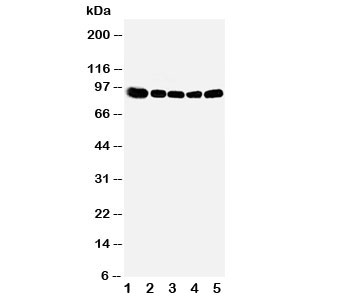
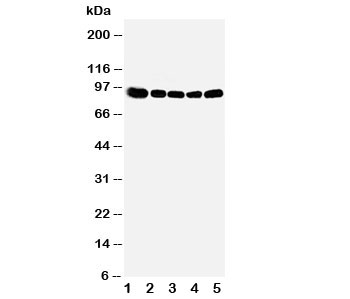
Oxysterol-Binding Protein is a protein that in humans is encoded by the OSBP gene. Im et al.(2005) reported the structure of the full-length yeast oxysterol-binding-protein Osh4, a member of the OSBP-related protein (ORP) family, at 1.5- to 1.9-angstrom resolution in complexes with ergosterol, cholesterol, and 7-, 20- and 25-hydroxy cholesterol. Moreira et al.(2001) refined the localization of the OSBP1 gene to chromosome 11q12.1 by radiation hybrid analysis. Wang et al.(2005) found that OSBP functions as a cholesterol-binding scaffolding protein coordinating the activity of 2 phosphatases to control the extracellular signal-regulated kinase (ERK) signaling pathway. Cytosolic OSBP formed an approximately 440-kD oligomer with a member of the PTPPBS family of tyrosine phosphatases, the serine/threonine phosphatase PP2A, and cholesterol.
Formulation
0.5mg/ml if reconstituted with 0.2ml sterile DI water
Host
Rabbit
Immunogen Region
An amino acid sequence from the middle region of human Oxysterol-Binding Protein (WQKSLQYERDQRIRL) was used as the immunogen for this OSBP antibody (100% homologous in human, mouse and rat).
Isotype
IgG
Predicted Reactivity
Human, Mouse, Rat
Reactivity
Human, Mouse, Rat
Recombinant
No
Antigen
OSBP
Uniprot
P22059
Format
Antigen affinity purified
Purification
Antigen affinity
Storage
After reconstitution, the OSBP antibody can be stored for up to one month at 4°C. For long-term, aliquot and store at -20°C. Avoid repeated freezing and thawing.
 Loading ....