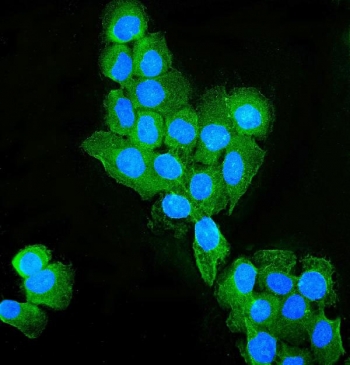
Occludin is an integral membrane protein that is located at tight junctions. It is a member of a family of proteins containing the highly conserved Marvel domain, which contains 4 transmembrane-helix regions. This gene is mapped to 5q13.2. Occludin regulates TGF-beta receptor type I localization for efficient TGF-beta-dependent dissolution of tight junctions during epithelial-mesenchymal transitions. Human Occludin is an essential hepatitis C virus (HCV) cell entry factor that is able to render murine cells infectable with HCV glycoproteins. It has been found that occludin is involved in cell migration and functions to recruit active PI3 kinase to the leading edge, resulting in RAC1 activation and formation of lamellipodia.
Formulation
0.5mg/ml if reconstituted with 0.2ml sterile DI water
Host
Rabbit
Immunogen Region
Recombinant human protein (amino acids H54-K270) was used as the immunogen for the OCLN antibody.
Isotype
IgG
Predicted Reactivity
Human
Reactivity
Human
Recombinant
No
Antigen
Occludin
Uniprot
Q16625
Buffer
Lyophilized from 1X PBS with 2% Trehalose and 0.025% sodium azide
Format
Antigen affinity purified
Purification
Affinity purified
Storage
After reconstitution, the OCLN antibody can be stored for up to one month at 4°C. For long-term, aliquot and store at -20°C. Avoid repeated freezing and thawing.
Applications
Direct ELISA, IHC-P, IF, WB, FACS
Dilution
Western blot: 0.5-1ug/ml,Immunohistochemistry: 1-2ug/ml,Immunofluorescence: 2-4ug/ml,Flow cytometry: 1-3ug/million cells,Direct ELISA: 0.1-0.5ug/ml
 Loading ....