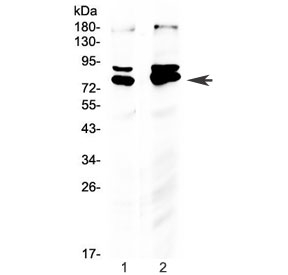
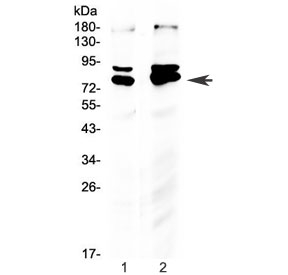
Nuclear Respiratory Factor 1 is also known as Alpha-Pal. Efiok et al.(1994) identified genes containing NRF1-binding sequences and found that these could be classified either as cellular proliferation genes, or as genes regulating the growth-responsive metabolic pathways of energy transduction, translation, and replication. Virbasius and Scarpulla(1994) noted that the nuclear-encoded mitochondrial transcription factor<a href=http://www.nsjbio.com/search_result.php?search_txt=tfam>TFAM</a>contains potential binding sites for NRF1, NRF2(GABPA) and SP1 within the promoter region. With use of binding and electrophoretic mobility shift assays, DNase footprinting, and mutation analysis of recombinant proteins, they demonstrated specific and functional binding of<a href=http://www.nsjbio.com/search_result.php?search_txt=nrf1>NRF1</a>and<a href=http://www.nsjbio.com/search_result.php?search_txt=nrf2>NRF2</a>to the TFAM promoter region.
Formulation
0.5mg/ml if reconstituted with 0.2ml sterile DI water
Host
Rabbit
Immunogen Region
An amino acid sequence from the middle region of human Nuclear Respiratory Factor 1 (QHGREDLLYAFEDQQTQ) was used as the immunogen for this NRF1 antibody (100% homologous in human, mouse and rat).
Isotype
IgG
Predicted Reactivity
Human, Mouse, Rat
Reactivity
Rat, Human, Mouse
Recombinant
No
Antigen
NRF1
Uniprot
Q16656
Format
Antigen affinity purified
Purification
Antigen affinity
Storage
After reconstitution, the NRF1 antibody can be stored for up to one month at 4°C. For long-term, aliquot and store at -20°C. Avoid repeated freezing and thawing.
Applications
IHC-P, WB, ICC
Dilution
Western blot: 0.5-1ug/ml,Immunohistochemistry (FFPE): 0.5-1ug/ml,Immunocytochemistry: 0.5-1ug/ml
 Loading ....