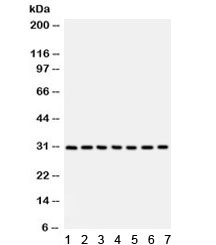
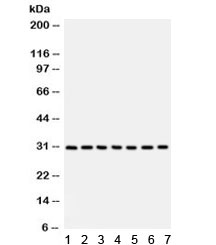
This gene is a member of the NAD(P)H dehydrogenase (quinone) family and encodes a cytoplasmic 2-electron reductase. And this FAD-binding protein forms homodimers and reduces quinones to hydroquinones. In addition, this protein's enzymatic activity prevents the one electron reduction of quinones that results in the production of radical species. Mutations in this gene have been associated with tardive dyskinesia (TD), an increased risk of hematotoxicity after exposure to benzene, and susceptibility to various forms of cancer. Altered expression of this protein has been seen in many tumors and is also associated with Alzheimer's disease (AD). Alternate transcriptional splice variants, encoding different isoforms, have been characterized.
Formulation
0.5mg/ml if reconstituted with 0.2ml sterile DI water
Host
Rabbit
Immunogen Region
Amino acids EVQDEEKNKKFGLSVGHHLGKSIPTDNQIKARK of human NQO1 were used as the immunogen for the NQO1 antibody.
Isotype
IgG
Predicted Reactivity
Human, Rat
Reactivity
Rat, Human
Recombinant
No
Antigen
NQO1
Uniprot
P15559
Format
Antigen affinity purified
Purification
Antigen affinity
Storage
After reconstitution, the NQO1 antibody can be stored for up to one month at 4°C. For long-term, aliquot and store at -20°C. Avoid repeated freezing and thawing.
 Loading ....