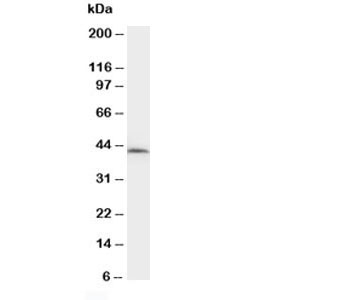
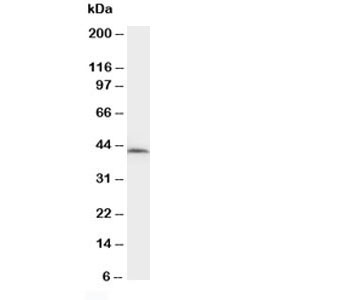
NPHS2, also called Podocin (PDCN), is a protein which lines the podocytes and assists in maintaining the barrier at the glomerular basement membrane. NPHS2 is a causative gene for Familial idiopathic nephrotic syndromes, which represents a heterogeneous group of kidney disorders, and include autosomal recessive steroid-resistant nephrotic syndrome, which is characterized by early childhood onset of proteinuria, rapid progression to end-stage renal disease and focal segmental glomerulosclerosis. By positional cloning, it was mapped to 1q25-31. It is almost exclusively expressed in the podocytes of fetal and mature kidney glomeruli, and encodes a new integral membrane protein, podocin, belonging to the stomatin protein family. Boute et al.(2000) found ten different NPHS2 mutations, comprising nonsense, frameshift and missense mutations, to segregate with the disease, demonstrating a crucial role for podocin in the function of the glomerular filtration barrier.
Formulation
0.5mg/ml if reconstituted with 0.2ml sterile DI water
Host
Rabbit
Immunogen Region
An amino acid sequence from the middle region of human NPHS2 (CVKVVQEYERVIIFRLGH) was used as the immunogen for this NPHS2 antibody.
Isotype
IgG
Predicted Reactivity
Human, Mouse, Rat
Reactivity
Human, Mouse, Rat
Recombinant
No
Antigen
NPHS2
Uniprot
Q9NP85
Format
Antigen affinity purified
Purification
Antigen affinity
Storage
After reconstitution, the NPHS2 antibody can be stored for up to one month at 4°C. For long-term, aliquot and store at -20°C. Avoid repeated freezing and thawing.
 Loading ....