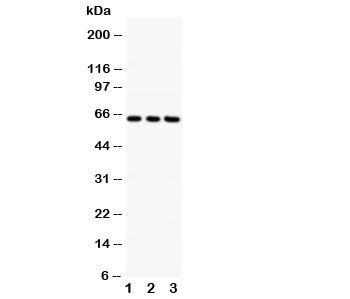
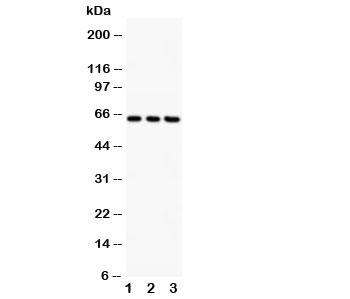
NADPH OXIDASE 1, also known as NOH1, MOX1 or GP91-2, is an enzyme that in humans is encoded by the NOX1 gene. It is also a homolog of the catalytic subunit of the superoxide-generating NADPH oxidase of phagocytes, gp91phox. It is expressed in colon, prostate, uterus, and vascular smooth muscle, but not in peripheral blood leukocytes. The deduced 564-amino acid NOX1 protein, which is 58% identical to CYBB, contains 6 membrane-spanning regions, conserved flavin and pyridine nucleotide-binding sites, and histidines possibly involved in heme ligation. Overexpression of NOX1 in NIH3T3 cells increased superoxide generation and cell growth. Cells expressing NOX1 had a transformed appearance, showed anchorage-independent growth, and produced tumors in athymic mice. Disruption of either Nox1 or Nox2 significantly delayed progression of motor neuron disease in these mice. However, 50% survival rates were enhanced significantly more by Nox2 deletion than Nox1 deletion.
Formulation
0.5mg/ml if reconstituted with 0.2ml sterile DI water
Host
Rabbit
Immunogen Region
An amino acid sequence from the middle region of rat NOX1 (WYKFQRAHNKLKTQK) was used as the immunogen for this NOX1 antibody.
Isotype
IgG
Predicted Reactivity
Mouse, Rat
Reactivity
Mouse, Rat
Recombinant
No
Antigen
NOX1
Uniprot
Q9WV87
Format
Antigen affinity purified
Purification
Antigen affinity
Storage
After reconstitution, the NOX1 antibody can be stored for up to one month at 4°C. For long-term, aliquot and store at -20°C. Avoid repeated freezing and thawing.
Applications
IHC-P, WB
Dilution
Western blot: 0.5-1ug/ml,Immunohistochemistry (FFPE): 0.5-1ug/ml
 Loading ....