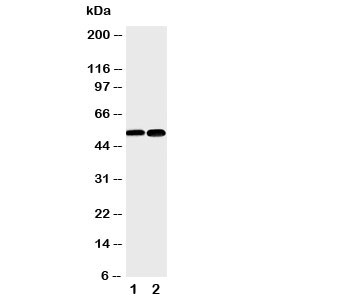
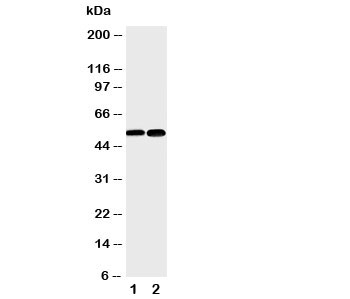
Nuclear Factor Kappa-B, Subunit 2, also known as NFKB or p52/p100 subunit, is a protein that in humans is encoded by the NFKB2 gene. Liptay et al.(1992) mapped the gene for what they called the p49/p100 subunit of NFKB to chromosome 10 by Southern blot analysis of panels of human/Chinese hamster cell hybrids. By fluorescence in situ hybridization(FISH), they confirmed the localization and mapped the gene with greater resolution to 10q24. NFKB2 appears to be the same as LYT10. Claudio et al.(2002) showed that bone marrow(BM) cells from Nfkb2-deficient mice, but not Nfkb1-deficient mice, failed to increase relative and total IgD-positive transitional-1(T1) stage B cells in response to Baff. In vivo, however, Nfkb2-deficient mice did generate mature B cells, but at reduced numbers. Mice of the aly/aly strain, which are naturally deficient in Nik, and mice of the A/WySNJ strain, which have a mutation in Baffr, also failed to produce T1 B cells in response to Baff. Baff stimulation enhanced expression of Bcl2 in T1 B cells, thereby promoting B-cell survival, and caused the processing of the p100 form of the protein to p52, which again required Baffr and Nik, but not Nemo(IKKG). Immunoblot analysis showed that BM cells contained primarily p100.
Formulation
0.5mg/ml if reconstituted with 0.2ml sterile DI water
Host
Rabbit
Immunogen Region
An amino acid sequence from the N-terminus of mouse NFKB2 (YDPGLDGIPEYDDFEFS) was used as the immunogen for this NFKB2 (100% rat homology).
Isotype
IgG
Predicted Reactivity
Mouse, Rat
Reactivity
Mouse, Rat
Recombinant
No
Antigen
NFKB2
Uniprot
Q9WTK5
Format
Antigen affinity purified
Purification
Antigen affinity
Storage
After reconstitution, the NFKB2 antibody can be stored for up to one month at 4°C. For long-term, aliquot and store at -20°C. Avoid repeated freezing and thawing.
Applications
IHC-P, WB
Dilution
Western blot: 0.5-1ug/ml,Immunohistochemistry (FFPE): 0.5-1ug/ml
 Loading ....