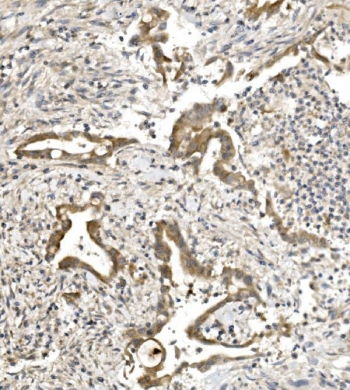
The NECTIN1 gene encodes an adhesion protein that plays a role in the organization of adherens junctions and tight junctions in epithelial and endothelial cells. The protein is a calcium(2+)-independent cell-cell adhesion molecule that belongs to the immunoglobulin superfamily and has 3 extracellular immunoglobulin-like loops, a single transmembrane domain (in some isoforms), and a cytoplasmic region. This protein acts as a receptor for glycoprotein D (gD) of herpes simplex viruses 1 and 2 (HSV-1, HSV-2), and pseudorabies virus (PRV) and mediates viral entry into epithelial and neuronal cells. Mutations in this gene cause cleft lip and palate/ectodermal dysplasia 1 syndrome (CLPED1) as well as non-syndromic cleft lip with or without cleft palate (CL/P). Alternative splicing results in multiple transcript variants encoding proteins with distinct C-termini.
Formulation
0.5mg/ml if reconstituted with 0.2ml sterile DI water
Host
Rabbit
Immunogen Region
Recombinant human protein (amino acids V32-E237) was used as the immunogen for the Nectin 1 antibody.
Isotype
IgG
Predicted Reactivity
Human, Mouse, Rat
Reactivity
Mouse, Rat, Human
Recombinant
No
Antigen
Nectin 1
Uniprot
Q15223
Buffer
Lyophilized from 1X PBS with 2% Trehalose and 0.025% sodium azide
Format
Antigen affinity purified
Purification
Affinity purified
Storage
After reconstitution, the Nectin 1 antibody can be stored for up to one month at 4°C. For long-term, aliquot and store at -20°C. Avoid repeated freezing and thawing.
Applications
IHC-P, FACS, WB, Direct ELISA
Dilution
Western blot: 0.5-1ug/ml,Immunohistochemistry: 1-2ug/ml,Flow cytometry: 1-3ug/million cells,Direct ELISA: 0.1-0.5ug/ml
 Loading ....