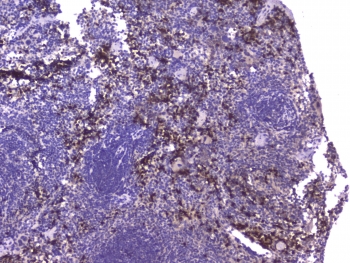
CCL8, also known as monocyte chemoattractant protein 2 (MCP2), is a protein that in humans is encoded by the CCL8 gene. It is a small cytokine belonging to the CC chemokine family. The CCL8 protein is produced as a precursor containing 109 amino acids, which is cleaved to produce mature CCL8 containing 75 amino acids. The gene for CCL8 is encoded by 3 exons and is located within a large cluster of CC chemokines on chromosome 17q11.2 in humans. MCP-2 is chemotactic for and activates many different immune cells, including mast cells, eosinophils and basophils, (that are implicated in allergic responses), and monocytes, T cells, and NK cells that are involved in the inflammatory response. CCL8 elicits its effects by binding to several different cell surface receptors called chemokine receptors. These receptors include CCR1, CCR2B, CCR3 and CCR5.
Formulation
0.5mg/ml if reconstituted with 0.2ml sterile DI water
Host
Rabbit
Immunogen Region
Amino acids G24-P97 from the mouse protein were used as the immunogen for the Mcp2 antibody.
Isotype
IgG
Predicted Reactivity
Mouse, Rat
Reactivity
Mouse, Rat
Recombinant
No
Subcellular Location
Secreted
Antigen
Mcp2
Uniprot
Q9Z121
Format
Purified
Purification
Antigen affinity purified
Storage
After reconstitution, the Mcp2 antibody can be stored for up to one month at 4°C. For long-term, aliquot and store at -20°C. Avoid repeated freezing and thawing.
 Loading ....