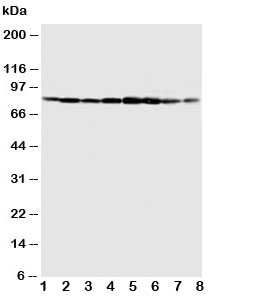
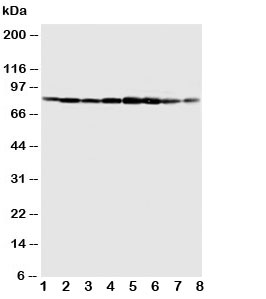
Minichromosome Maintenance, s. Cerevisiae, homolog of, 7, also called CDC47, is one of the highly conserved mini-chromosome maintenance proteins (MCM) that are essential for the initiation of eukaryotic genome replication. MCM7 plays a pivotal role in the G1/S phase transition, orchestrating the correct assembly of replication forks on chromosomal DNA and ensuring that all the genome is replicated once and not more than once at each cell cycle. The gene contains 15 exons. The miRNAs MIR106B, MIR93, and MIR25 are clustered in a 5-prime to 3-prime orientation within intron 13. Petrocca et al.(2008) found that MCM7 and the precursors of microRNAs(miRNAs) MIR106B, MIR93, and MIR25, all of which arise from intron 13 of the MCM7 gene, were overexpressed with almost perfect correlation in 5 of 10 human gastric tumors.
Formulation
0.5mg/ml if reconstituted with 0.2ml sterile DI water
Host
Rabbit
Immunogen Region
An amino acid sequence from the C-terminus of human MCM7 (DEYEELNVWQVNASRTRITFV) was used as the immunogen for this MCM7 antibody.
Isotype
IgG
Predicted Reactivity
Human
Reactivity
Human
Recombinant
No
Antigen
MCM7
Uniprot
P33993
Format
Antigen affinity purified
Purification
Antigen affinity
Storage
After reconstitution, the MCM7 antibody can be stored for up to one month at 4°C. For long-term, aliquot and store at -20°C. Avoid repeated freezing and thawing.
Applications
FACS, ICC, IHC-P, WB
Dilution
Western blot: 0.5-1ug/ml,Immunohistochemistry (FFPE): 0.5-1ug/ml,Immunocytochemistry: 0.5-1ug/ml,Flow cytometry: 1-3ug/million cells
 Loading ....