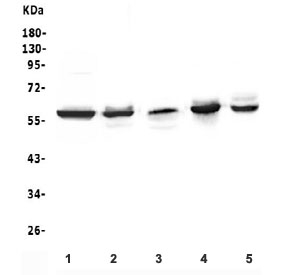
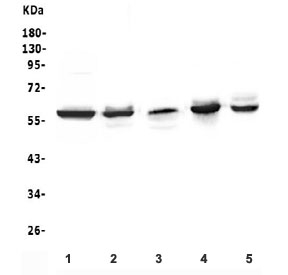
Lck (or lymphocyte-specific protein tyrosine kinase) is a protein found inside specialized cells of the immune system called lymphocytes. The human LCK gene is mapped to chromosome 1p35-p32. This gene is a member of the Src family of protein tyrosine kinases (PTKs). The encoded protein is a key signaling molecule in the selection and maturation of developing T-cells. It contains N-terminal sites for myristylation and palmitylation, a PTK domain, and SH2 and SH3 domains which are involved in mediating protein-protein interactions with phosphotyrosine-containing and proline-rich motifs, respectively. The protein localizes to the plasma membrane and pericentrosomal vesicles, and binds to cell surface receptors, including CD4 and CD8, and other signaling molecules. Multiple alternatively spliced variants, encoding the same protein, have been described.
Formulation
0.5mg/ml if reconstituted with 0.2ml sterile DI water
Host
Rabbit
Immunogen Region
Amino acids ELYQLMRLCWKERPEDRPTFDYLRSVLEDFFTATEGQYQ of human Lymphocyte-specific protein tyrosine kinase were used as the immunogen for the LCK antibody.
Isotype
IgG
Predicted Reactivity
Human, Mouse, Rat
Reactivity
Mouse, Rat, Human
Recombinant
No
Subcellular Location
Cytoplasmic
Antigen
LCK
Uniprot
P06239
Buffer
Lyophilized from 1X PBS with 2% Trehalose and 0.025% sodium azide
Format
Antigen affinity purified
Purification
Antigen affinity
Storage
After reconstitution, the LCK antibody can be stored for up to one month at 4°C. For long-term, aliquot and store at -20°C. Avoid repeated freezing and thawing.
Applications
IHC-P, ICC, WB, FACS
Dilution
Western blot: 0.1-0.5ug/ml,Immunohistochemistry (FFPE): 0.5-1ug/ml,Immunocytochemistry: 2-4ug/ml,Flow cytometry: 1-3ug/10^6 cells
 Loading ....