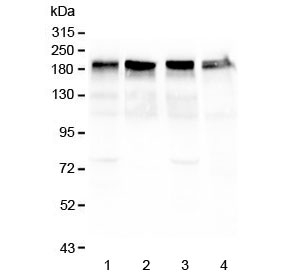
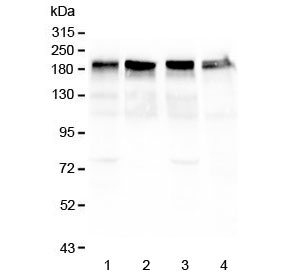
Laminins are major proteins in the basal lamina (one of the layers of the basement membrane), a protein network foundation for most cells and organs. Laminins form independent networks and are associated with type IV collagen networks via entactin, fibronectin, and perlecan. They are important and biologically active parts of the basal lamina, influencing cell differentiation, migration, and adhesion, as well as phenotype and survival. Laminins are trimeric proteins that contain an ?-chain, a ?-chain, and a ?-chain, found in five, four, and three genetic variants, respectively. Laminins critically contribute to cell attachment and differentiation, cell shape and movement, maintenance of tissue phenotype, and promotion of tissue survival.
Formulation
0.5mg/ml if reconstituted with 0.2ml sterile DI water
Host
Rabbit
Immunogen Region
Amino acid sequences from Laminin gamma 1-3 (NKLNEIEGSLNKAKDEMKAS + DLEERVRRQRNHLHLLETSI + LQLDSHGALHHKLRQLEEES) were used as the immunogen for the Laminin gamma antibody.
Isotype
IgG
Predicted Reactivity
Human, Mouse, Rat
Reactivity
Human, Mouse, Rat
Recombinant
No
Subcellular Location
Membrane, secreted (cytoplasmic in some tissue)
Antigen
Laminin
Uniprot
P02468, Q61092, Q9R0B6
Buffer
Lyophilized from 1X PBS with 2.5% BSA, 0.025% sodium azide
Format
Antigen affinity purified
Purification
Antigen affinity
Storage
After reconstitution, the Laminin gamma antibody can be stored for up to one month at 4°C. For long-term, aliquot and store at -20°C. Avoid repeated freezing and thawing.
Applications
IHC-P, WB
Dilution
Western Blot: 0.5-1ug/ml,Immunohistochemistry (FFPE): 1-2ug/ml
 Loading ....