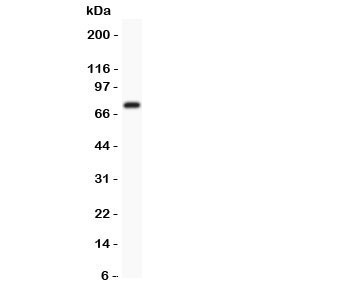
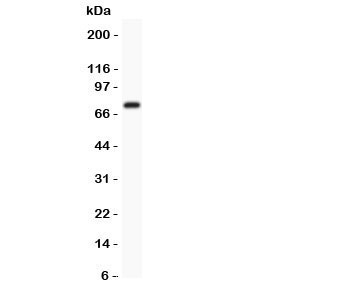
Potassium voltage-gated channel subfamily D member 3, also known as Kv4.3, is a protein that in humans is encoded by the KCND3 gene. Kv4.3 is a member of the potassium channel, voltage-gated, shal-related subfamily. Voltage-gated potassium (Kv) channels represent the most complex class of voltage-gated ion channels from both functional and structural standpoints. Their diverse functions include regulating neurotransmitter release, heart rate, insulin secretion, neuronal excitability, epithelial electrolyte transport, smooth muscle contraction, and cell volume. It is mapped to 1p13.2. Kv4.3 is important in membrane repolarization in excitable cells. It contributes to the cardiac transient outward potassium current (Ito1), the main contributing current to the repolarizing phase 1 of the cardiac action potential.
Formulation
0.5mg/ml if reconstituted with 0.2ml sterile DI water
Host
Rabbit
Immunogen Region
Human partial recombinant protein (AA 1-177) was used as the immunogen for this Kv4.3 antibody.
Isotype
IgG
Predicted Reactivity
Human, Mouse
Reactivity
Mouse, Human
Recombinant
No
Antigen
Kv4.3
Gene Id
3752
Format
Antigen affinity purified
Purification
Antigen affinity
Storage
After reconstitution, the Kv4.3 antibody can be stored for up to one month at 4°C. For long-term, aliquot and store at -20°C. Avoid repeated freezing and thawing.
 Loading ....