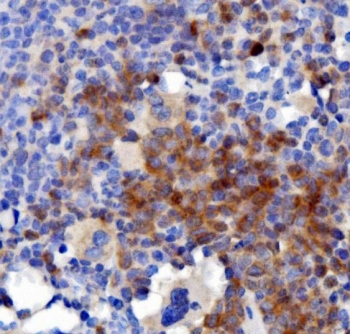
Interleukin 3, also known as IL-3, is a protein that in humans is encoded by the IL3 gene. It is mapped to 5q31.1. IL-3 is an interleukin, a type of biological signal (cytokine) that can improve the body's natural response to disease as part of the immune system. It acts by binding to the interleukin-3 receptor. IL-3 stimulates the differentiation of multipotent hematopoietic stem cells into myeloid progenitor cells or, with the addition of IL-7, into lymphoid progenitor cells. In addition, IL-3 stimulates proliferation of all cells in the myeloid lineage (granulocytes, monocytes, and dendritic cells), in conjunction with other cytokines, e.g., Erythropoietin (EPO), Granulocyte macrophage colony-stimulating factor (GM-CSF), and IL-6. IL-3 is secreted by basophils and activated T cells to support growth and differentiation of T cells from the bone marrow in an immune response.
Formulation
0.5mg/ml if reconstituted with 0.2ml sterile DI water
Host
Rabbit
Immunogen Region
A mouse recombinant partial protein (amino acids E91-C166) was used as the immunogen for the Interleukin 3 antibody.
Isotype
IgG
Predicted Reactivity
Mouse
Reactivity
Mouse
Recombinant
No
Antigen
IL3
Uniprot
P01586
Format
Antigen affinity purified
Purification
Affinity purified
Storage
After reconstitution, the Interleukin 3 antibody can be stored for up to one month at 4°C. For long-term, aliquot and store at -20°C. Avoid repeated freezing and thawing.
Applications
Direct ELISA, IHC-P, WB
Dilution
Western blot: 1-2ug/ml,Immunohistochemistry (FFPE): 2-5ug/ml,Direct ELISA: 0.1-0.5ug/ml
 Loading ....