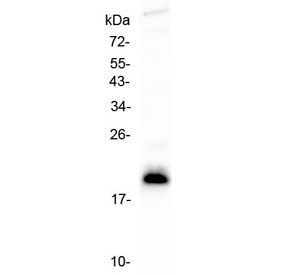
Interleukin-4 (IL-4), also known as a B-cell stimulatory factor1 (BSF1), is an immunomodulatory cytokine, which can inhibit the growth of tumour cells.1 The human cDNA contains a single open reading frame encoding a protein of 153 amino acids, including a putative signal peptide. IL-4 may act as an autocrine growth factor in pancreatic cancer cells and also give rise to the possibility that cancer-derived IL-4 may suppress cancer-directed immunosurveillance in vivo in addition to its growth-promoting effects, thereby facilitating pancreatic tumor growth and metastasis. The mouse and human genes and their protein products show structural and functional similarities.
Formulation
0.5mg/ml if reconstituted with 0.2ml sterile DI water
Host
Rabbit
Immunogen Region
A recombinant human protein corresponding to amino acids H25-S153 was used as the immunogen for the IL-4 antibody.
Isotype
IgG
Predicted Reactivity
Human
Reactivity
Human
Recombinant
No
Antigen
IL-4
Uniprot
P05112
Buffer
Lyophilized from 1X PBS with 2% Trehalose and 0.025% sodium azide
Format
Antigen affinity purified
Purification
Antigen affinity purified
Storage
After reconstitution, the IL-4 antibody can be stored for up to one month at 4°C. For long-term, aliquot and store at -20°C. Avoid repeated freezing and thawing.
Applications
WB, ELISA
Dilution
Western Blot: 0.5-1ug/ml,Direct ELISA: 0.1-0.5ug/ml
 Loading ....