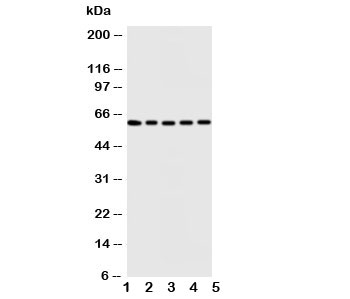
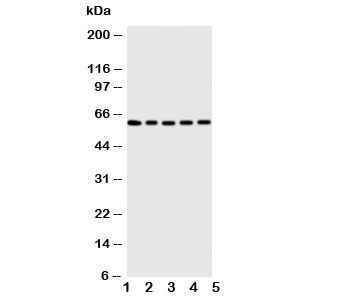
Iduronate 2 sulfatase (IDS) is an enzyme associated with Hunter syndrome. IDS is involved in the lysosomal degradation of the glycosaminoglycans heparan sulfate and dermatan sulfate. Wilson et al.(1991) used an IDS cDNA clone to localize the gene to Xq28, distal to the fragile X site. Faust et al.(1992) and Daniele et al.(1993) demonstrated that the homologous Ids gene in the mouse occupies the same position on the X chromosome in relation to the FMR1, F9, and GABRA3 genes. IDS is required for the lysosomal degradation of heparan sulfate and dermatan sulfate. Mutations in this X-chromosome gene that result in enzymatic deficiency lead to the sex-linked mucopolysaccharidosis type II, also known as Hunter syndrome. Iduronate 2 sulfatase has a strong sequence homology with human arylsulfatases A, B, and C, and human glucosamine-6sulfatase.
Formulation
0.5mg/ml if reconstituted with 0.2ml sterile DI water
Host
Rabbit
Immunogen Region
An amino acid sequence from the C-terminus of human IDS (ELCREGKNLLKHFRFRDLE) was used as the immunogen for this Iduronate 2 sulfatase antibody.
Isotype
IgG
Predicted Reactivity
Human
Reactivity
Human
Recombinant
No
Antigen
Iduronate 2 sulfatase
Uniprot
P22304
Format
Antigen affinity purified
Purification
Antigen affinity
Storage
After reconstitution, the Iduronate 2 sulfatase antibody can be stored for up to one month at 4°C. For long-term, aliquot and store at -20°C. Avoid repeated freezing and thawing.
Applications
WB, IHC-P
Dilution
Western blot: 0.5-1ug/ml,Immunohistochemistry (FFPE): 0.5-1ug/ml
 Loading ....