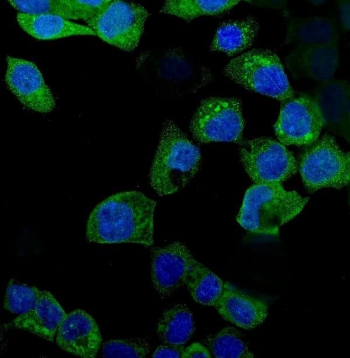
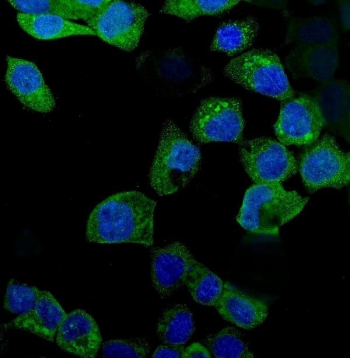
IDO1 (INDOLEAMINE 2,3-DIOXYGENASE), INDO or IDO, is an immunomodulatory enzyme produced by some alternatively activated macrophages and other immunoregulatory cells. This enzyme catalyzes the degradation of the essential amino acid L-tryptophan to N-formyl-kynurenine. By fluorescence in situ hybridization, the assignment is narrowed to chromosome 8p12-p11. INDO Interferon-gamma has an antiproliferative effect on many tumor cells and inhibits intracellular pathogens such as Toxoplasma and chlamydia, at least partly because of the induction of indoleamine 2,3-dioxygenase. During inflammation, IDO is upregulated in dendritic cells and phagocytes by proinflammatory stimuli, most notably IFNG, and the enzyme then uses superoxide as a 'cofactor' for oxidative cleavage of the indole ring of tryptophan, yielding an intermediate that deformylates to L-kynurenine.
Formulation
0.5mg/ml if reconstituted with 0.2ml sterile DI water
Host
Rabbit
Immunogen Region
Amino acids NDWMFIAKHLPDLIESGQLRERVEKLNMLSIDH of human IDO1 were used as the immunogen for the IDO1 antibody.
Isotype
IgG
Predicted Reactivity
Human, Mouse, Rat
Reactivity
Rat, Mouse, Human
Recombinant
No
Subcellular Location
Cytoplasmic
Antigen
IDO1
Uniprot
P14902
Format
Antigen affinity purified
Purification
Antigen affinity
Storage
After reconstitution, the IDO1 antibody can be stored for up to one month at 4°C. For long-term, aliquot and store at -20°C. Avoid repeated freezing and thawing.
 Loading ....