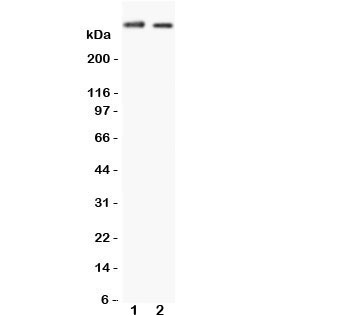
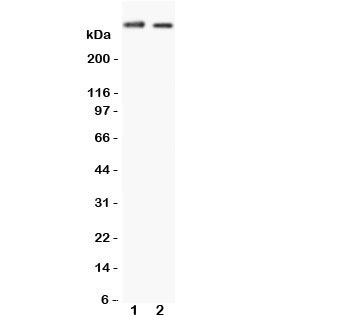
The Huntingtin gene, also called HTT or HD (Huntington disease), is the IT15 (interesting transcript 15) gene which codes for a protein called the Huntingtin. The protein has no sequence homology with other proteins and is highly expressed in neurons and tests in humans and rodents. HTT upregulates the expression of Brain Derived Neurotrophic Factor (BDNF) at the transcription level, and this gene is required for normal development. HTT is involved in vesicle trafficking as it interacts with HIP1, a clathrin-binding protein, to mediate endocytosis, the absorption of materials into a cell. HTT was also visualized as punctate staining likely to represent nerve endings. Additionally, wildtype Huntingtin may function in the nucleus in the assembly of nuclear matrix-bound protein complexes involved with transcriptional repression and RNA processing.
Formulation
0.5mg/ml if reconstituted with 0.2ml sterile DI water
Host
Rabbit
Immunogen Region
An amino acid sequence from the C-terminus of human HTT (ELDRRAFQSVLEVVAA) was used as the immunogen for this Huntingtin antibody.
Isotype
IgG
Predicted Reactivity
Human, Mouse, Rat
Reactivity
Human, Mouse, Rat
Recombinant
No
Antigen
Huntingtin
Uniprot
P42858
Format
Antigen affinity purified
Purification
Antigen affinity
Storage
After reconstitution, the Huntingtin antibody can be stored for up to one month at 4°C. For long-term, aliquot and store at -20°C. Avoid repeated freezing and thawing.
 Loading ....