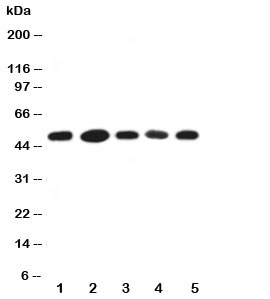
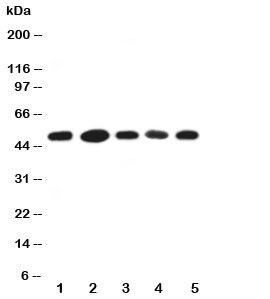
Suppression of Tumorigenicity 13, also known as p48 or HIP, is a protein that in humans is encoded by the ST13 gene. ST13 is an abundant, highly conserved protein that binds the major cytosolic chaperones heat-shock protein 70-kD (HSP70) and HSP90 during an intermediate stage of steroid receptor assembly, but is absent from the mature receptor complex. Zhang et al.(1998) mapped the gene to chromosome 22q13 by fluorescence in situ hybridization. They noted that colorectal, breast, and ovarian carcinomas frequently show loss of heterozygosity at this site. Using a yeast 2-hybrid assay, Hohfeld et al.(1995) showed that rat HIP bound Hsc70(HSPA8). One oligomer bound the ATPase domains of at least two Hsc70 molecules, and binding was dependent on activation of the Hsc70 ATPase by Hsp40(DNAJB1). HIP stabilized the ADP-bound form of Hsc70, which had a high affinity for a test protein substrate. Hohfeld et al.(1995) concluded that the protein contributes to interactions of HSC70 with target proteins through its own chaperone activity.
Formulation
0.5mg/ml if reconstituted with 0.2ml sterile DI water
Host
Rabbit
Immunogen Region
An amino acid sequence from the N-terminus of human HSC70 Interacting Protein (MDPRKVNELRAFVKMCKQD) was used as the immunogen for this HIP antibody.
Isotype
IgG
Predicted Reactivity
Human
Reactivity
Human
Recombinant
No
Antigen
HIP
Uniprot
P50502
Format
Antigen affinity purified
Purification
Antigen affinity
Storage
After reconstitution, the HIP antibody can be stored for up to one month at 4°C. For long-term, aliquot and store at -20°C. Avoid repeated freezing and thawing.
 Loading ....