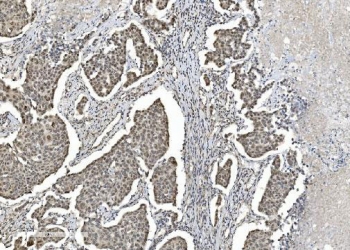
Histone deacetylase 5, also called HDAC5 or KIAA0600, is an enzyme that in humans is encodes by the HDAC5 gene. The protein encoded by this gene belongs to the class II histone deacetylase/acuc/apha family. This gene is mapped to 17q21.31. Histones play a critical role in transcriptional regulation, cell cycle progression, and developmental events. Histone acetylation/deacetylation alters chromosome structure and affects transcription factor access to DNA. It possesses histone deacetylase activity and represses transcription when tethered to a promoter. It coimmunoprecipitates only with HDAC3 family member and might form multicomplex proteins. It also interacts with myocyte enhancer factor-2(MEF2) proteins, resulting in repression of MEF2-dependent genes. This gene is though to be associated with colon cancer.
Formulation
0.5mg/ml if reconstituted with 0.2ml sterile DI water
Host
Rabbit
Immunogen Region
Recombinant human protein (amino acids R13-H1107) was used as the immunogen for the HDAC5 antibody.
Isotype
IgG
Predicted Reactivity
Human, Mouse, Rat
Reactivity
Rat, Mouse, Human
Recombinant
No
Subcellular Location
Nuclear, cytoplasmic
Antigen
HDAC5
Uniprot
Q9UQL6
Buffer
Lyophilized from 1X PBS with 2% Trehalose and 0.025% sodium azide
Format
Antigen affinity purified
Purification
Affinity purified
Storage
After reconstitution, the HDAC5 antibody can be stored for up to one month at 4°C. For long-term, aliquot and store at -20°C. Avoid repeated freezing and thawing.
Applications
Direct ELISA, FACS, IF, IHC-P, WB
Dilution
Western blot: 0.5-1ug/ml,Immunohistochemistry: 1-2ug/ml,Immunofluorescence: 2-4ug/ml,Flow cytometry: 1-3ug/million cells,Direct ELISA: 0.1-0.5ug/ml
 Loading ....