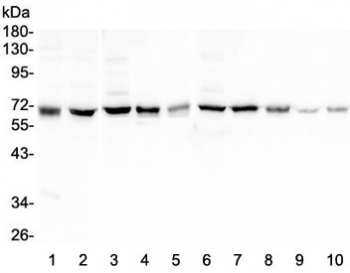
Hyaluronan synthase 1 is an enzyme that in humans is encoded by the HAS1 gene. This gene is mapped to 19q13.41. Hyaluronan or hyaluronic acid (HA) is a high molecular weight unbranched polysaccharide synthesized by a wide variety of organisms from bacteria to mammals, and is a constituent of the extracellular matrix. It consists of alternating glucuronic acid and N-acetylglucosamine residues that are linked by beta-1-3 and beta-1-4 glycosidic bonds. It serves a variety of functions, including space filling, lubrication of joints, and provision of a matrix through which cells can migrate. HA is actively produced during wound healing and tissue repair to provide a framework for ingrowth of blood vessels and fibroblasts. AS1 is a member of the newly identified vertebrate gene family encoding putative hyaluronan synthases, and its amino acid sequence shows significant homology to the hasA gene product of Streptococcus pyogenes, a glycosaminoglycan synthetase (DG42) from Xenopus laevis, and a recently described murine hyaluronan synthase.
Formulation
0.5mg/ml if reconstituted with 0.2ml sterile DI water
Host
Rabbit
Immunogen Region
Amino acids NRAEDLYMVDMFREVFADEDPATYVWDGNYHQPWEPA were used as the immunogen for the HAS1 antibody.
Isotype
IgG
Predicted Reactivity
Human, Mouse, Rat
Reactivity
Rat, Mouse, Human
Recombinant
No
Antigen
HAS1
Uniprot
Q92839
Buffer
Lyophilized from 1X PBS with 2% Trehalose and 0.025% sodium azide
Format
Antigen affinity purified
Purification
Antigen affinity purified
Storage
After reconstitution, the HAS1 antibody can be stored for up to one month at 4°C. For long-term, aliquot and store at -20°C. Avoid repeated freezing and thawing.
Applications
FACS, ICC, IF, IHC-P, WB
Dilution
Western blot: 0.5-1ug/ml,Immunohistochemistry (FFPE): 1-2ug/ml,Immunofluorescence/Immunocytochemistry: 2-4ug/ml,Flow cytometry: 1-3ug/million cells
 Loading ....