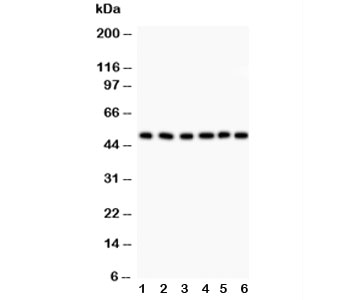
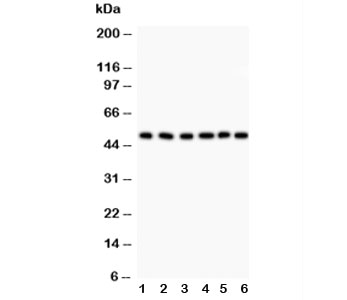
Glial fibrillary acidic protein is a protein that is encoded by the GFAP gene in humans. It is an intermediate filament (IF) protein that is expressed by numerous cell types of the central nervous system (CNS) including astrocytes, and ependymal cells. It is mapped to 17q21.31. It is closely related to its non-epithelial family members, vimentin, desmin, and peripherin, which are all involved in the structure and function of the cells cytoskeleton. GFAP is thought to help to maintain astrocyte mechanical strength, as well as the shape of cells. This gene has been shown to play a role in mitosis by adjusting the filament network present in the cell. It is necessary for many critical roles in the CNS. It also plays a role in astrocyte-neuron interactions as well as cell-cell communication.
Formulation
0.5mg/ml if reconstituted with 0.2ml sterile DI water
Host
Rabbit
Immunogen Region
Human partial recombinant protein (AA 93-432) was used as the immunogen for this GFAP antibody.
Isotype
IgG
Predicted Reactivity
Human, Mouse, Rat
Reactivity
Rat, Human, Mouse
Recombinant
No
Antigen
GFAP
Gene Id
2670
Buffer
Lyophilized from 1X PBS with 2% Trehalose and 0.025% sodium azide
Format
Antigen affinity purified
Purification
Antigen affinity
Storage
After reconstitution, the GFAP antibody can be stored for up to one month at 4°C. For long-term, aliquot and store at -20°C. Avoid repeated freezing and thawing.
Applications
IHC-P, WB, IF
Dilution
Western blot: 0.5-1ug/ml,Immunohistochemistry (FFPE): 0.5-1ug/ml,Immunofluorescence (FFPE): 1-2ug/ml
 Loading ....