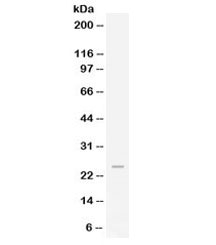
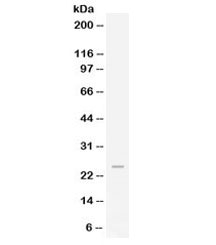
FGF19, Fibroblast growth factor 19, is a protein that in humans is encoded by the FGF19 gene. The protein encoded by this gene is a member of the fibroblast growth factor (FGF) family. The FGF19 gene is mapped to 11q13.3. The deduced 216-amino acid FGF19 protein contains asignal sequence and 2 cysteine residues that are conserved in the FGF family. Expression of this gene was detected only in fetal but not adult brain tissue. Synergistic interaction of the chick homolog and Wnt-8c has been shown to be required for initiation of inner ear development. FGF19 stimulates hepatic protein and glycogen synthesis but does not induce lipogenesis. The effects of FGF19 are independent of the activity of either insulin or the protein kinase Akt and, instead, are mediated through a mitogen-activated protein kinase signaling pathway that activates components of the protein translation machinery and stimulates glycogen synthase activity. FGF19 is the orthologous protein in humans. They are often referred together as FGF15/19.
Formulation
0.5mg/ml if reconstituted with 0.2ml sterile DI water
Host
Rabbit
Immunogen Region
Amino acids L25-K216 from the human protein were used as the immunogen for the FGF19 antibody.
Isotype
IgG
Predicted Reactivity
Human
Reactivity
Human
Recombinant
No
Antigen
FGF19
Uniprot
O95750
Buffer
Lyophilized from 1X PBS with 2.5% BSA and 0.025% sodium azide
Format
Antigen affinity purified
Purification
Antigen affinity
Storage
After reconstitution, the FGF19 antibody can be stored for up to one month at 4°C. For long-term, aliquot and store at -20°C. Avoid repeated freezing and thawing.
Applications
WB, ELISA
Dilution
Western blot: 0.5-2ug/ml,ELISA: 0.5-1ug/ml (human protein tested); request BSA-free format for coating
 Loading ....