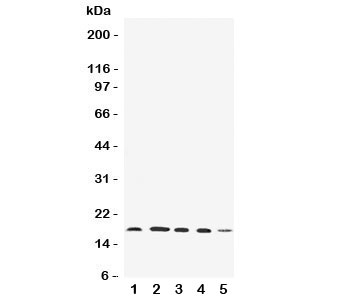
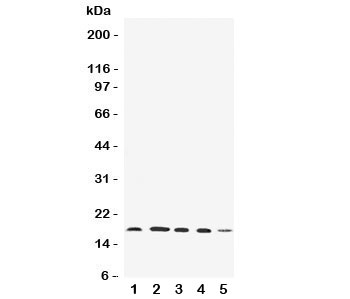
Ubiquitin D, Diubiquitin or FAT10 (HLA-F-adjacent transcript 10), is a protein that in humans is encoded by the UBD gene. It is a ubiquitin-like protein modifier that can be covalently attached to target protein and subsequently leads to their degradation by the 26S proteasome in a NUB1L-dependent manner. This gene may be involved in dendritic cell (DC) maturation, the process by which immature dendritic cells differentiate into fully competent antigen-presenting cells that initiate T-cell responses. It may be involved in the formation of aggresomes when proteasome is saturated or impaired. FAT10 mediates apoptosis in a caspase-dependent manner, especially in renal epithelium and tubular cells during renal diseases such as polycystic kidney disease and Human immunodeficiency virus (HIV)-associated nephropathy (HIVAN). It may also function as a survival factor.
Formulation
0.5mg/ml if reconstituted with 0.2ml sterile DI water
Host
Rabbit
Immunogen Region
An amino acid sequence from the N-terminus of human HLA-F-adjacent transcript 10 (YDSVKKIKEHVRSK) was used as the immunogen for this FAT10 antibody.
Isotype
IgG
Predicted Reactivity
Human
Reactivity
Human
Recombinant
No
Antigen
FAT10
Uniprot
O15205
Format
Antigen affinity purified
Purification
Antigen affinity
Storage
After reconstitution, the FAT10 antibody can be stored for up to one month at 4°C. For long-term, aliquot and store at -20°C. Avoid repeated freezing and thawing.
Applications
WB, IHC-P
Dilution
Western blot: 0.5-1ug/ml,Immunohistochemistry (FFPE): 0.5-1ug/ml
 Loading ....