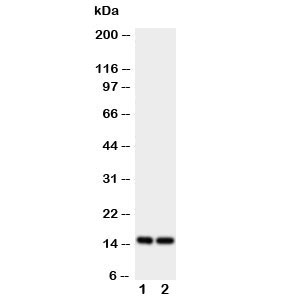
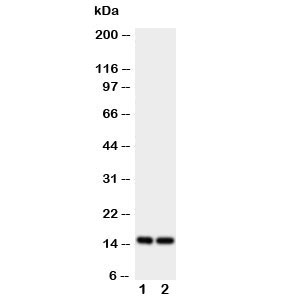
Fatty acid binding protein 5 (psoriasis-associated) is a protein that in humans is encoded by the FABP5 gene, also known as PAFABP, EFABP, E-FABP, KFABP, PA-FABP, and Epidermal-type fatty acid-binding protein. It is a family of small, highly conserved, cytoplasmic proteins that bind long-chain fatty acids and other hydrophobic ligands. The cDNA encodes a 135-amino acid protein with molecular weight 15,164. This gene encodes the fatty acid binding protein found in epidermal cells, and was first identified as being upregulated in psoriasis tissue. It is though that FABPs roles include fatty acid uptake, transport, and metabolism. Kaczocha et al.(2009) identified FABP5 and FABP7 as cytosolic proteins that transport AEA from the plasma membrane to subcellular fatty acid amide hydrolase, where it is hydrolyzed and inactivated. FABP3 did not show this specific transport function.
Formulation
0.5mg/ml if reconstituted with 0.2ml sterile DI water
Host
Rabbit
Immunogen Region
Amino acids 10-23 (KWRLMESHGFEEYM-mouse) were used as the immunogen for this FABP5 antibody.
Isotype
IgG
Predicted Reactivity
Mouse, Rat
Reactivity
Mouse, Rat
Recombinant
No
Antigen
FABP5
Uniprot
Q05816
Format
Antigen affinity purified
Purification
Antigen affinity
Storage
The lyophilized FABP5 antibody can be stored at 4°C to -20°C. After reconstitution, aliquot and store at -20°C. Avoid repeated freeze/thaws.
Applications
IHC-P, WB
Dilution
Western blot: 0.5-1ug/ml,Immunohistochemistry (FFPE): 0.5-1ug/ml
 Loading ....