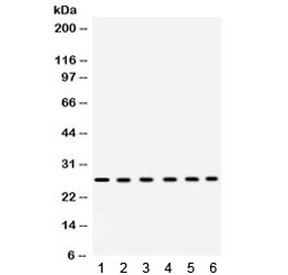
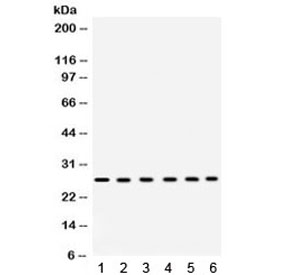
EIF6 (Eukaryotic Translation Initiation Factor 6), also called EIF3A or ITGB4BP, is a human gene. By fluorescence in situ hybridization, Sanvito et al. (1998) mapped the ITGB4BP gene to 20q11.2. Ceci et al. (2003) demonstrated that the ribosomal 60S subunit is activated by release of EIF6. In the cytoplasm, EIF6 is bound to free 60S but not to 80S subunits. Furthermore, EIF6 interacts in the cytoplasm with RACK1, a receptor for activated protein kinase C. Gandin et al. (2008) demonstrated that mammalian eIF6 is required for efficient initiation of translation in vivo. Eif6-null mouse embryos were lethal at preimplantation. Heterozygous mice had 50% reduction of eIF6 levels in all tissues, and showed reduced mass of hepatic and adipose tissues due to a lower number of cells and to impaired G1/S cell cycle progression.
Formulation
0.5mg/ml if reconstituted with 0.2ml sterile DI water
Host
Rabbit
Immunogen Region
Amino acids 66-210 of human EIF6/EIF3A were used as the immunogen for the EIF3A antibody.
Isotype
IgG
Predicted Reactivity
Human, Mouse, Rat
Reactivity
Rat, Human, Mouse
Recombinant
No
Subcellular Location
Nuclear and cytoplasmic
Antigen
EIF6
Uniprot
P56537
Format
Antigen affinity purified
Purification
Antigen affinity
Storage
After reconstitution, the EIF3A antibody can be stored for up to one month at 4°C. For long-term, aliquot and store at -20°C. Avoid repeated freezing and thawing.
Applications
IHC-P, WB, ICC
Dilution
Western blot: 0.1-0.5ug/ml,Immunohistochemistry (FFPE): 0.5-1ug/ml,ICC (Paraffin): 0.5-1ug/ml
 Loading ....