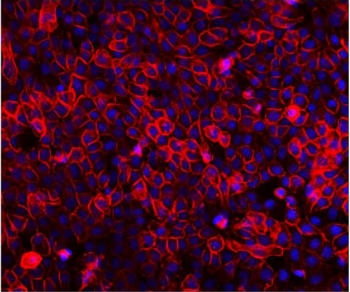
The epidermal growth factor receptor (EGFR; ErbB-1; HER1 in humans) is the cell-surface receptor for members of the epidermal growth factor family (EGF-family) of extracellular protein ligands. It is a member of the ErbB family of receptors, a subfamily of four closely related receptor tyrosine kinases: EGFR (ErbB-1), HER2/c-neu (ErbB-2), Her 3 (ErbB-3) and Her 4 (ErbB-4). EGFR exists on the cell surface and is activated by binding of its specific ligands, including epidermal growth factor and transforming growth factor ? (TGF?). EGFR and its ligands are cell signaling molecules involved in diverse cellular functions, including cell proliferation, differentiation, motility, and survival, and in tissue development. Mutations that lead to EGFR over[removed]known as upregulation) or overactivity have been associated with a number of cancers, including lung cancer and glioblastoma multiforme. In this latter case a more or less specific mutation of EGFR, called EGFRvIII is often observed.
Formulation
0.5mg/ml if reconstituted with 0.2ml sterile DI water
Host
Rabbit
Immunogen Region
Recombinant human protein (amino acids N36-N497) was used as the immunogen for the EGF Receptor antibody.
Isotype
IgG
Predicted Reactivity
Human, Mouse, Rat
Reactivity
Rat, Mouse, Human
Recombinant
No
Antigen
EGF Receptor / EGFR
Uniprot
P00533
Buffer
Lyophilized from 1X PBS with 2% Trehalose and 0.025% sodium azide
Format
Antigen affinity purified
Purification
Affinity purified
Storage
After reconstitution, the EGF Receptor antibody can be stored for up to one month at 4°C. For long-term, aliquot and store at -20°C. Avoid repeated freezing and thawing.
Applications
Direct ELISA, FACS, IF, IHC-P, WB
Dilution
Western blot: 0.5-1ug/ml,Immunohistochemistry: 1-2ug/ml,Immunofluorescence: 2-4ug/ml,Flow cytometry: 1-3ug/million cells,Direct ELISA: 0.1-0.5ug/ml
 Loading ....