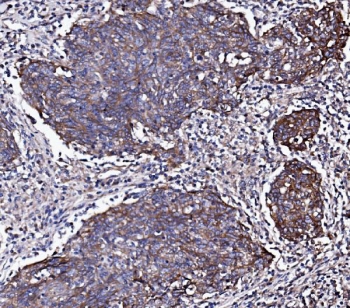
The epidermal growth factor receptor (EGFR; ErbB-1; HER1 in humans) is the cell-surface receptor for members of the epidermal growth factor family (EGF-family) of extracellular protein ligands. It is a member of the ErbB family of receptors, a subfamily of four closely related receptor tyrosine kinases: EGFR (ErbB-1), HER2/c-neu (ErbB-2), Her 3 (ErbB-3) and Her 4 (ErbB-4). EGFR exists on the cell surface and is activated by binding of its specific ligands, including epidermal growth factor and transforming growth factor alpha (TGFalpha). EGFR and its ligands are cell signaling molecules involved in diverse cellular functions, including cell proliferation, differentiation, motility, and survival, and in tissue development. Mutations that lead to EGFR over[removed]known as upregulation) or overactivity have been associated with a number of cancers, including lung cancer and glioblastoma multiforme. In this latter case a more or less specific mutation of EGFR, called EGFRvIII is often observed.
Formulation
0.5mg/ml if reconstituted with 0.2ml sterile DI water
Host
Rabbit
Immunogen Region
Recombinant human protein (amino acids D1006-A1210) was used as the immunogen for the EGF Receptor antibody.
Isotype
IgG
Predicted Reactivity
Human
Reactivity
Human
Recombinant
No
Antigen
EGF Receptor / EGFR
Uniprot
P00533
Buffer
Lyophilized from 1X PBS with 2% Trehalose and 0.025% sodium azide
Format
Antigen affinity purified
Purification
Affinity purified
Storage
After reconstitution, the EGF Receptor antibody can be stored for up to one month at 4°C. For long-term, aliquot and store at -20°C. Avoid repeated freezing and thawing.
Applications
Direct ELISA, IHC-P, IF, WB, FACS
Dilution
Western blot: 0.5-1ug/ml,Immunohistochemistry: 1-2ug/ml,Immunofluorescence: 2-4ug/ml,Flow cytometry: 1-3ug/million cells,Direct ELISA: 0.1-0.5ug/ml
 Loading ....