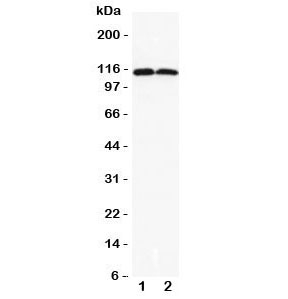
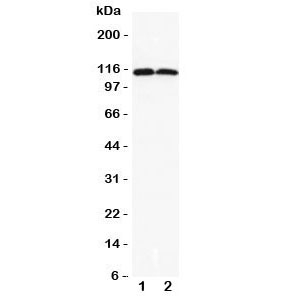
Anoctamin-1 (ANO1), also known as oral cancer overexpressed 2 (ORAOV2), Tumor-amplified and overexpressed sequence 2 (TMEM16A), and Discovered on gastrointestinal stromal tumors protein 1 (DOG1) is a protein that in humans is encoded by the ANO1 gene. This gene belongs to a family of membrane proteins containing 8 transmembrane segments, and it is mapped to 11q13.3. ANO1 is a candidate calcium-activated chloride channel that mediates receptor-activated chloride currents in diverse physiologic processes, and it is though to be responsible for a voltage-sensitive calcium-activated chloride current. Its overexpression was reported in esophageal squamous cell carcinoma and breast cancer progression Crofelemer, an antidiarrhoeal, inhibits this channel. ANO1/DOG1 has eight transmembrane domains, its pore is large and non-selective, allowing other negatively charged species to permeate.
Formulation
0.5mg/ml if reconstituted with 0.2ml sterile DI water
Host
Rabbit
Immunogen Region
An amino acid sequence from the C-terminus of human ANO1/TMEM16A/DOG1 (KVLMVELFMREEQDKQQ) was used as the immunogen for this DOG1 antibody.
Isotype
IgG
Predicted Reactivity
Human, Mouse, Rat
Reactivity
Human, Mouse, Rat
Recombinant
No
Antigen
DOG1
Uniprot
Q5XXA6
Format
Antigen affinity purified
Purification
Antigen affinity
Storage
After reconstitution, the DOG1 antibody can be stored for up to one month at 4°C. For long-term, aliquot and store at -20°C. Avoid repeated freezing and thawing.
 Loading ....